Unlock your People Power Tools and Resources

...solve thorny business challenges in the time it takes to drink a cup of tea
Fail to grow your people, and you fail to grow your business...
These tools and resources are based on Any Dumb-Ass Can Do It, by Garry Ridge (with Martha Finney) and One Page Talent Management, by Marc Effron and Miriam Ort.

@Magnific
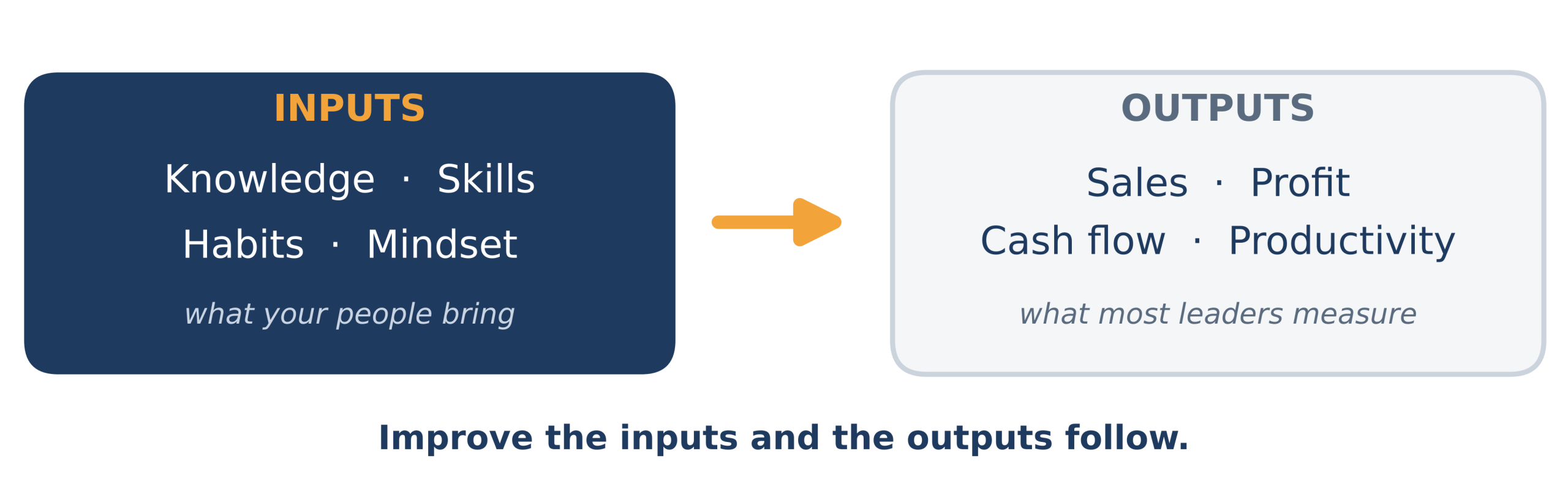
Your Business Breakthrough report makes one simple argument: businesses only grow when people grow. You can measure sales, profit, and cash flow every month, but those numbers are outputs. They come from what your people know, the skills they have, the habits they have built, and how they think. Improve those inputs and the outputs follow. Your report explains why, but these tools and resources will show you how to implement this within your business so that it becomes habitual.
It draws on two books that agree on something relatively unfashionable: it doesn't need to be complicated.
Garry Ridge, who led WD-40 Company for 25 years, built a culture around ‘learning moments’ and around making sure people know that they matter.
Marc Effron and Miriam Ort, who developed One Page Talent Management (OPTM), worked with businesses including Avon, Bank of America, and Philips, and found that simple tools that managers actually use beat clever systems they avoid.
Ridge gives you the mindset.
Effron and Ort give you the method.
Together they came up with tools you can use in your business today to build skills to practice and habits to keep.
STOP treating annual or bi-annual or quarterly appraisals as a necessary evil.
START by seeing appraisals as a critical moment of opportunity for each of your team members to improve, creating the conditions for your business to grow and succeed as well.
The one ‘BREAKTHROUGH QUESTION’ you must ask to help yourself if you want to unlock the people power in your business
“People who are happy in their work and are treated with respect and dignity will do extraordinary things." – Garry Ridge
Every business has a favourite question. For most, it is ‘did we hit the numbers?’
It is a good question, but it looks backwards at outputs, not forwards, and the results of your business only grow when you grow your people.
As a business leader, owner, or manager, are you giving your people the clarity and direction they need? Are expectations understood? Are the right conversations happening regularly? Are managers coaching, supporting, and developing their teams? Do your people have the skills, knowledge, confidence, and resources to do their jobs well? Are you recognising good work, tackling challenges early, and holding your people accountable for the things that matter?
And, perhaps most importantly, are you creating an environment where your people feel valued, trusted, and motivated to give their best?
These are the things that influence the numbers long before they appear on a spreadsheet.
When you look at the inputs, they help you understand what is driving performance – where things are working and where they need attention.
Rather than simply reacting to results after the event, you can influence them by improving the conditions that allow people to succeed. If you want better business results, start by looking at what you and your people are doing to make that happen.
Remember, better results follow when people grow, so the question that unlocks people power looks at the inputs, and at you. Here it is:
So, where is the value in this breakthrough question? Why does this question work?
- ‘This week’ makes it a habit, not an annual event. Ridge's view is that learning moments should be created regularly throughout the year, not saved up for a review.
- ‘Someone in my team’ keeps it specific. You can't help ‘everyone’ on a Friday, but you can help one person. Over a few months, this will add up to the names of all your team members, including strong performers who are easy to overlook, but who are just as important to help.
- ‘Learn, improve and know they matter’ is the heart of Ridge's approach at WD-40. People need to know that they matter, consistently, and that somebody takes a real interest in their future.
But how do you implement this in your business?
Firstly, make it a 10-minute habit, every Friday… then…
- Ask. Put ten minutes in your diary, same time every Friday, and read the question out loud.
- Answer in writing. Write one name and one specific action, for example: ‘Let Sam lead the supplier call, then talk it through with her.’ If the honest answer is ‘nothing’, write that down.
- Act on the gap. Anyone missing from the log for four weeks gets a 15-minute conversation in next week's diary.
Here is a quick checklist to ensure that this becomes a habit for you every week:
- Is the Friday question slot booked into my diary? Is it a weekly repeating event?
- Have I made a list of everyone I manage, including my strongest performers?
- Every Friday, talk to at least one member of the team and ensure that we both have a specific action.
- Ensure that I see all my team within a 4-week/month period.
- Where I could not give specific answers or where extra work is needed, a follow-up meeting has been booked.
- I told someone today that they are doing/did a good job.
You'll know it's working when you can name, without checking, something specific you have done to help each person in the last month.
You'll know it's working when you can name, without checking, something specific you have done to help each person in the last month.
Learning moments, not mistakes: make it safe to speak up
“The most important person I listen to every day is myself.” – Garry Ridge
Fear can be one of the biggest barriers to improvement. People hide problems, avoid difficult conversations, and stop suggesting improvements because they expect to be judged and, more than likely, don’t feel safe in their working environment.
Your job as a leader is to remove that fear with a change of language and a simple routine. It does not lower your standards; it often raises them, because problems come to the surface while they are still small and can often be dealt with easily and quickly before the tension and emotions rise.
Change the language that you use…
At WD-40, Ridge took the words ‘mistake’ and ‘failure’ out of everyday use. He used the words ‘learning moment’ as the outcome of any situation, positive or negative, and this phrase was used and shared openly.
Positive moments were shared so that others could copy them. Negative moments were shared so that nobody repeated them.
Same facts, same issues, but completely different behaviour and therefore completely different outcomes. By changing the language you use with your team, you move out of the blame loop and into the learning loop.
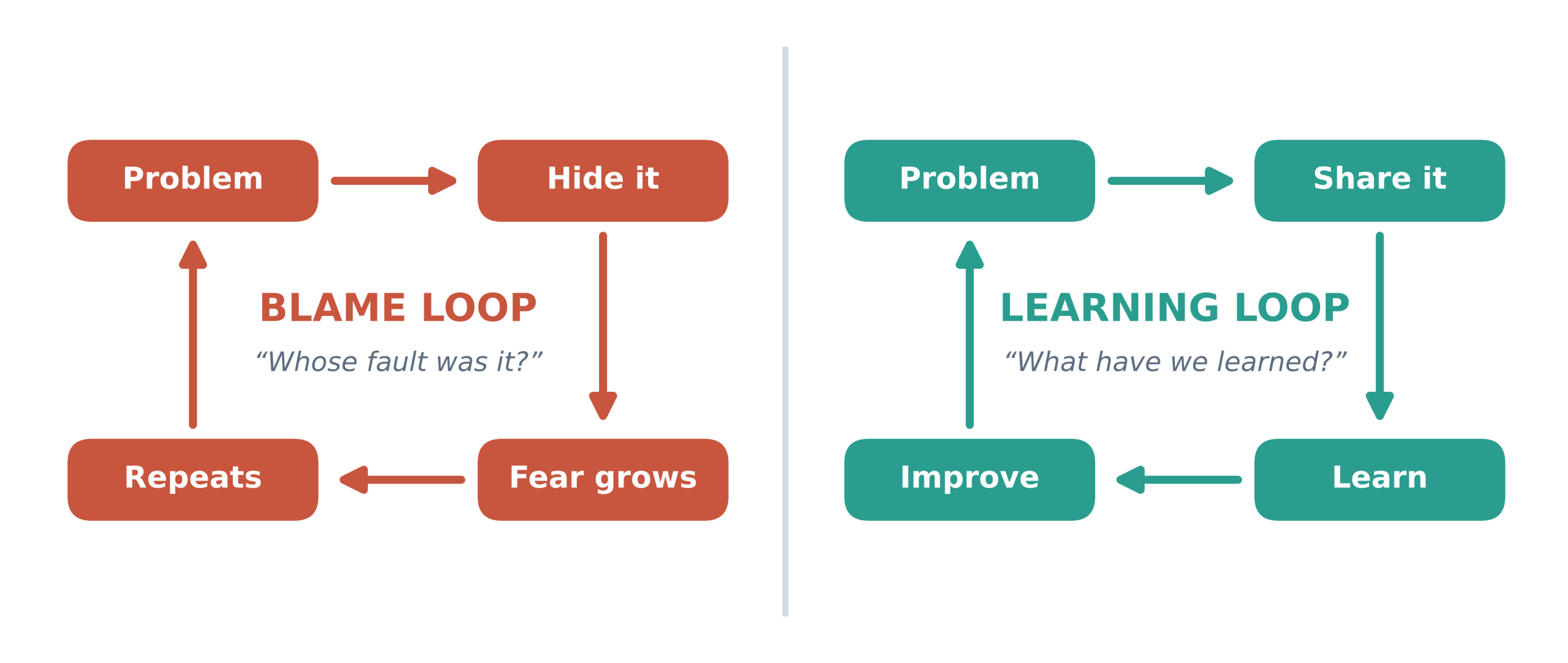
Taken from the book, Any Dumb-Ass Can Do It, by Garry Ridge
Before you respond to any issue, take a moment to think about the language you use, the words you say, and, most importantly, how you say them. Here are some examples of what TO and what NOT TO say:
Say this: What have we learned?
Not this: Whose fault is this?
Say this: Thanks for bringing this to my attention nice and early. What do you need from me, and how can I help support you?
Not this: Why did you not get this right, again?
Say this: What would you do differently next time to change the outcome?
Not this: How could you make such a stupid mistake?
Here are three questions that are learning moments. They only take five minutes, and, as Garry Ridge says, ‘they turn a problem into an opportunity for improvement.’
What happened? This is facts only, no blame, and let the person tell it first.
What have we learned? Ridge’s team question. Aim for one or two key lessons, not a whole list.
What will we do next time? Agree who does what and when, then follow it up and adjust the process to prevent repeat occurrences.
You will know it's working when your team shares problems, issues, and concerns openly and they or other members of your team are discussing the learning moments and processes and standards going forward.
The one-page review – a simple conversation that works
"Removing complexity from a talent process helps to ensure that the manager uses it; adding value helps ensure they use it the right way." – Marc Effron and Miriam Ort
Effron and Ort's conclusion is that only implementation matters, and complexity is the enemy of implementation. Their approach rests on simplicity, accountability, and transparency. The practical rule for you: if it doesn't fit on one page, it won't get used. Here is a one-page review you can copy, and some guidance for the conversation/questions that go with it.
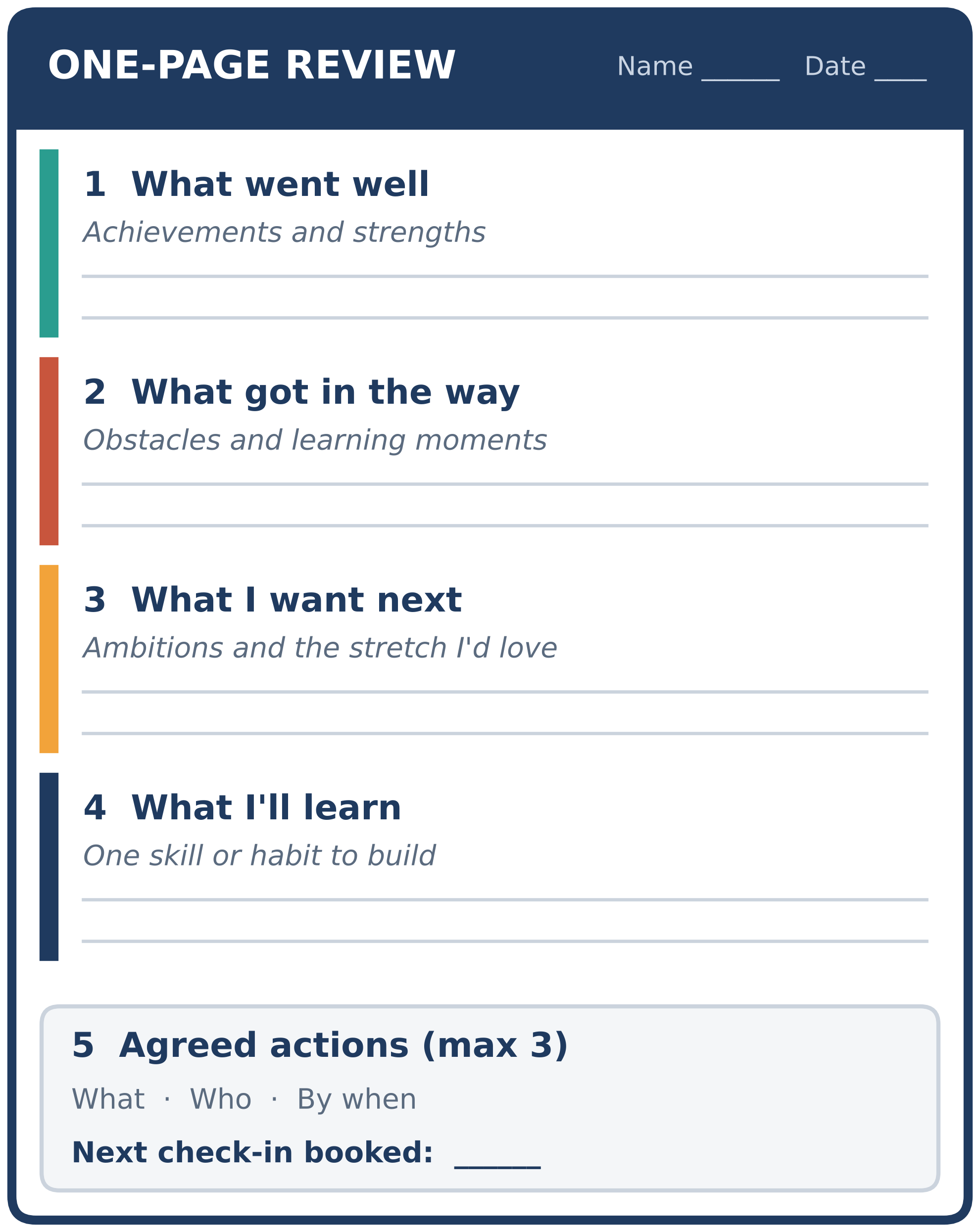
Run it in three steps:
- Prepare (10 minutes). Ask yourself: What has this team member done well, specifically? Where could they grow? What one stretch opportunity could I offer?
- Meet (45 to 60 minutes). Protect the time. Let them speak first and use boxes 1 to 4 as your agenda. Ask, listen, then summarise back; use the phrase ‘If I have heard you correctly’ to reinforce the fact that you have listened and understood what they are saying. Have the meeting off-site; a café or hired room works as well as a meeting room.
- Agree (5 minutes). Box 5: no more than three actions, each with an owner and a date. Book the next check-in before you leave the room.
Do it for your best performers as well. The business breakthrough report is clear that high performers often value development conversations most. Ignore them for too long and someone else will offer them the challenge.
And here are six questions that ensure you are on the coaching ‘learning moments’ path rather than on the judgement path:
- What are you most proud of since we last spoke?
- What got in the way, and what did you learn?
- What could you achieve next?
- What do you want to be doing in the next 12 months?
- What would you try if you knew it would work?
- How can I help with that?
You will know it's working when your team members start looking forward to their performance reviews, have lots of ideas to share, and feel confident talking more during the process.
The rhythm: small, regular conversations that keep it alive
“People will forget what you said, people will forget what you did, but people will never forget how you made them feel.” – Maya Angelou
Reviews fail when they happen only once a year. Gallup research, quoted in the Business Breakthrough report, links regular, meaningful feedback to higher engagement, and Ridge's advice is to create learning moments throughout the year rather than saving them up.
A simple rhythm does it:
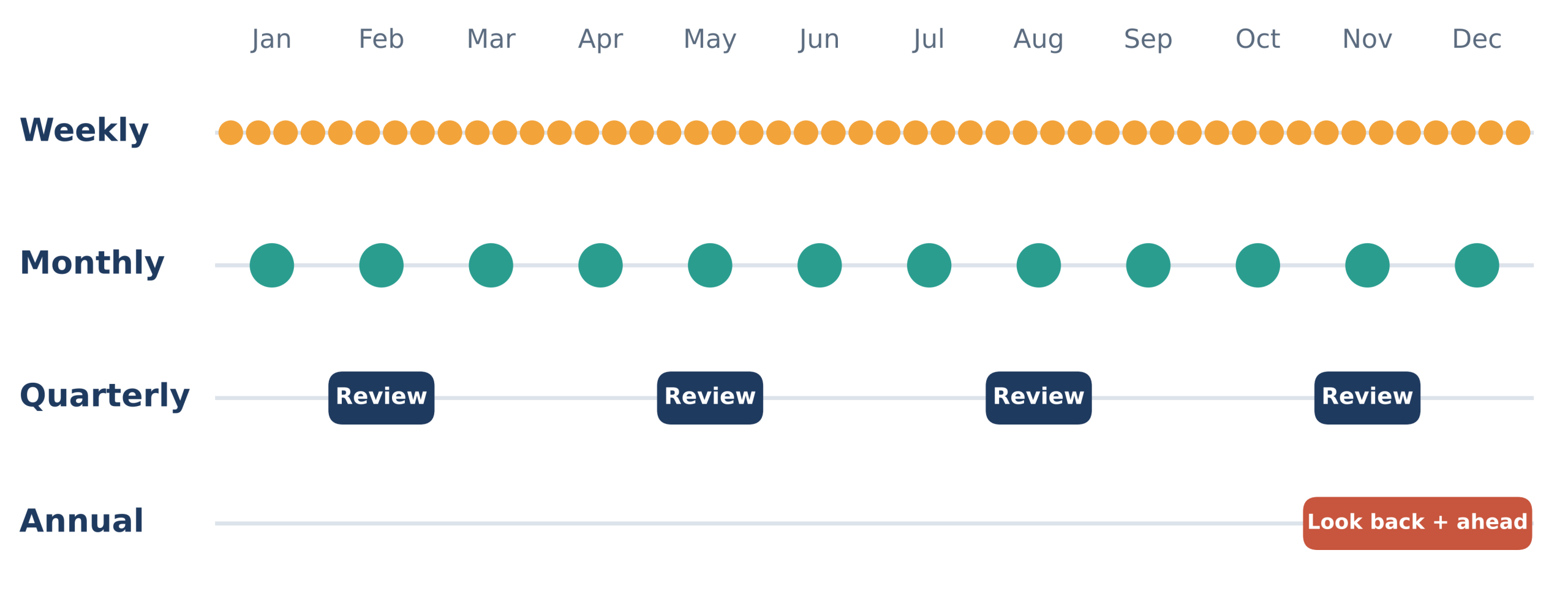
Bringing regular cadence to the process means the reviews happen weekly, monthly, quarterly, and yearly, that they are in your diary, and that they are not moved or postponed.
Think about the message this sends to your team about their importance and their value to your business.
Here is how they should work in terms of time and what is covered:
Weekly: 5-10 mins – A quick check-in, thanking them or recognising something they have done. A useful question is: ‘What went well this week?’
Monthly: 30 minutes – Checking the progress of projects; this identifies any obstacles and allows you to offer support. A useful question is: ‘What’s getting in the way, and what can I do to help?’
Quarterly: 60-90 mins – This is where the one-page review can be gone through in detail, and you can spend more time talking about their career development and goals for the future. A useful question is: ‘What could you achieve next?’
Annually: 90 minutes – This is a time to look back at the great work that has been done, discuss any issues they’ve had, and the learning opportunities that have come from it all. It’s also a chance to look ahead to the future in more detail. A useful question is: ‘What do you see yourself doing in 12 months?’
You will know it’s working when 12 months of reviews are in your diary, you are giving weekly feedback or thanks, you are asking the same questions each month (progress, obstacles, help), everyone is completing a one-page review, and you have not cancelled or moved any reviews.
Follow through and prove it's working
“The single biggest problem in communication is the illusion that it has taken place.” – George Bernard Shaw
Your Business Breakthrough report's fourth Helping Hand is: trust grows when promises become actions. Every forgotten action tells people their development doesn't matter, and every kept promise tells them it does.