Star People Save Time Tools and Resources

...solve thorny business challenges in the time it takes to drink a cup of tea
What if every manager and leader could reclaim 10%, 20%, or even 40% of their working week?
The information below is derived from the STAR® operational coaching framework: STOP. THINK. ASK. RESULT.Laura and Dominic Ashley-Timms. Validated by the London School of Economics across 62 organisations.

@Freepik
Most managers are promoted because they are brilliant at the work they do – solving problems, making decisions, and getting things done. But the same instinct that makes them successful as individuals may become the very thing that limits them as leaders. The more problems you solve for your team, the more problems they bring to you. The more you tell, the less they think. The busier you get, the less time you have to lead.
If you were able to release half a day, a full day, or even two days a week, you would be able to transform your results as a leader and manager and, in the process, transform the success and growth of your business.
The STAR® model can help you STOP and THINK, allowing you to take a moment before simply diving into helping one of your managers or a member of your team.
It’s this STOP and THINK that can make all the difference, but it requires focus and discipline, and, at the point of STOP, it requires you to ask a key question:
STOP thinking you are the only one who can solve the problems in your business
START triggering yourself to STOP
The one ‘BREAKTHROUGH QUESTION’ you must ask to help yourself…
“The difference between successful people and really successful people is that really successful people say no to almost everything.”– Warren Buffett
Most managers we speak to say the same thing: they went into leadership because they wanted to make a difference to their people, and, somewhere along the way, that got buried under a pile of meetings, decisions, and problems that never seem to stop arriving.
The days and weeks get away from them, with the ‘busyness’ of simply running a business.
To-do lists grow and the thought of adding 'coaching and developing my team' to an already impossible workload feels, frankly, like one thing too many.
Here's the difficult truth, though: the busier a manager gets, the more likely it is that their team is making them that way, though not deliberately, and not through any fault of their own.
This often happens because, when people learn that their manager will always have the answer, they stop looking for it themselves. Problems flow upward, and confidence and initiative vanish, with the result that you, the well-meaning, capable manager, work harder and harder, while your team become gradually more reliant and dependent on you.
This is where STAR comes in.
It doesn't ask you to find more time – it asks you to use the time you already have differently, employing a slightly different response in a conversation you were going to have anyway.
A question instead of an answer, a pause before you solve.
Small changes that, over time, shift the balance.
The result: Your team start thinking for themselves, you as a leader can start breathing again, and your whole business gets a little bit better at looking after the thing that matters most: your team.
The STAR model, developed by Laura and Dominic Ashley-Timms and proven through a major academic study conducted by the London School of Economics across 62 organisations, offers a different way.
It is a simple four-step framework…
STOP, THINK, ASK, RESULT
…that helps managers shift from a command-and-control style to what the authors call Operational Coaching®: a habit of asking rather than telling, right in the flow of everyday work.
These tools will show you what STAR looks like in practice and how to begin using it in your business today.
Lets go back to the question:
Before any framework, model, or tool will work, this is the single question every manager needs to be able to answer honestly.
Without it, STAR remains just another thing you have read about.
With it, everything else in these tools becomes possible.
This is the question you ask yourself, silently, before you speak, in any moment where a team member brings you a problem, a decision, or a challenge.
The question above is the gateway to STAR.
If your honest answer is yes, even a tentative 'probably yes', then you have a coachable moment on your hands.
That is your cue to STOP and THINK before you react.
If your answer is genuinely no, perhaps because there is a real safety issue, a legal requirement, or a genuine knowledge gap that only you can fill, then tell them clearly and efficiently.
STAR is not about avoiding all direction. It is about consciously choosing when to ask instead of to tell.
The question above is the engine of the whole STAR approach. Make it a habit to ask it to yourself in the moment, before every response, every email reply, every ‘oh, can I just pick your brains?’ conversation, and you will have taken the most important step of all.
Why it matters: Research by the LSE found that managers who adopted an enquiry-led approach spent 70% more time coaching their teams and won back an average of 20% of their working week, nearly a full day, all because their people started solving more problems themselves.
The STAR framework at a glance
“Instead of changing the behaviour of the other person… the STAR model focuses on changing our behaviour as managers.” - Laura Ashley-Timms and Dominic, The Answer is a Question
The STAR model is made up of four steps.
The first two: STOP and THINK. They happen inside your head before you speak. They are the most important.
The last two: ASK and RESULT. They are what you do in the conversation itself.
Here is how the model fits together.
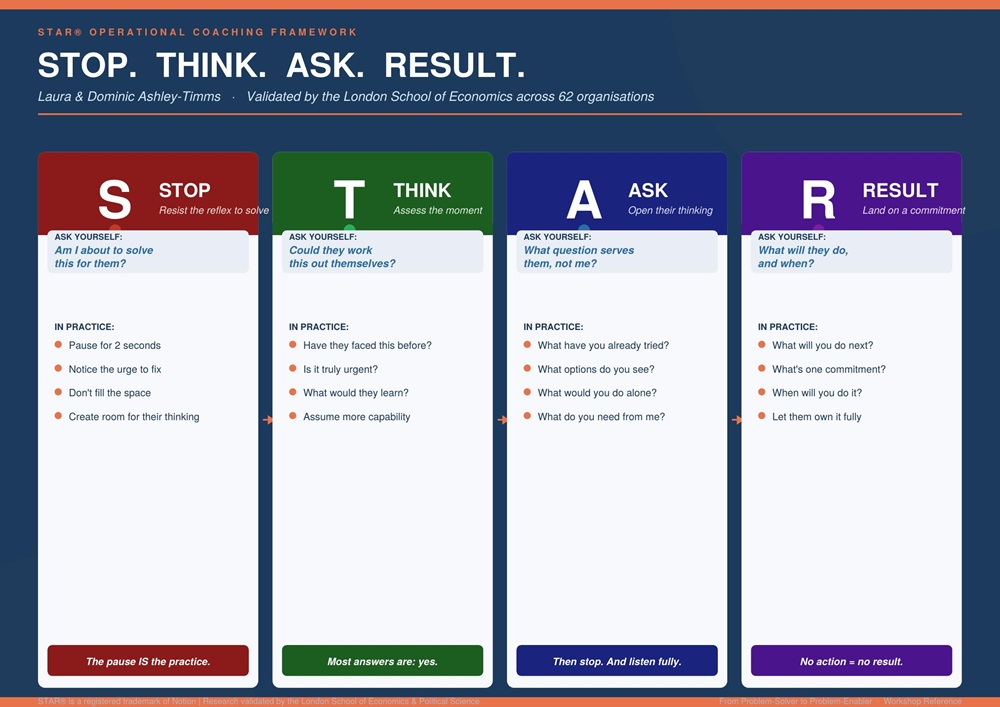
STOP – Change state, resist the reflex.
Your first instinct when someone brings you a problem is to solve it.
STOP is about interrupting that reflex.
Take a breath.
Step back mentally.
You cannot think clearly about whether to coach if you are already in solution mode.
THINK – Is this a coachable moment?
This is where you ask yourself the breakthrough question from above:
Do I believe the person in front of me has the potential to find a better answer to this than I could give them?
To expand on this idea, the question can be rephrased:
Does this person have the capacity to work through this themselves, with the right questions from me?
If yes, move to Ask. If genuinely no, give clear direction and move on.
ASK: Ask powerful questions and foster active listening.
Shift from telling to asking.
Use open questions: What, How, When, Who.
Avoid 'Why' as a first question, as it can feel accusatory. ‘Why have you done it like that?’ is not a good place to start.
Ask for their thinking, not yours. And when they answer, listen – really listen – before you respond.
RESULT: Agree on the next steps and desired outcome.
Every coaching conversation should end with clear, agreed-upon next steps that the other person owns. Ask them to commit to what they will do and by when. Then follow up – and be sure to put this follow up time in the diary – so that they and you know it will happen.
This is what turns a good conversation into genuine behaviour change.
The key insight of STAR is that it focuses on changing your behaviour as a manager, not theirs. When you consistently Stop, Think, Ask and seek a Result, the people around you naturally start to think differently, step up more, and bring you fewer problems over time.
The STAR Reference card
"Great results can be achieved with small forces" - Sun Tzu, Chinese general and philospher
The reference card below is designed to be your quick companion in the moment. Before a 1-2-1, a team meeting, or an ‘oh, can I just pick your brains?’ conversation, glance at it to remind yourself of the core moves at each stage of STAR.
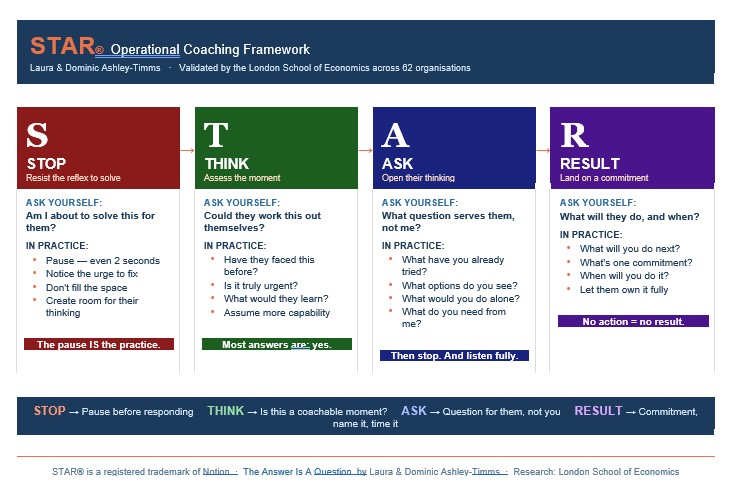
With regard to the pause: one of the most powerful things you can do during the Ask stage is to stay quiet after you ask a question.
Most managers fill silence with answers. Try to resist that, because the other person is thinking, and their thinking is the whole point.
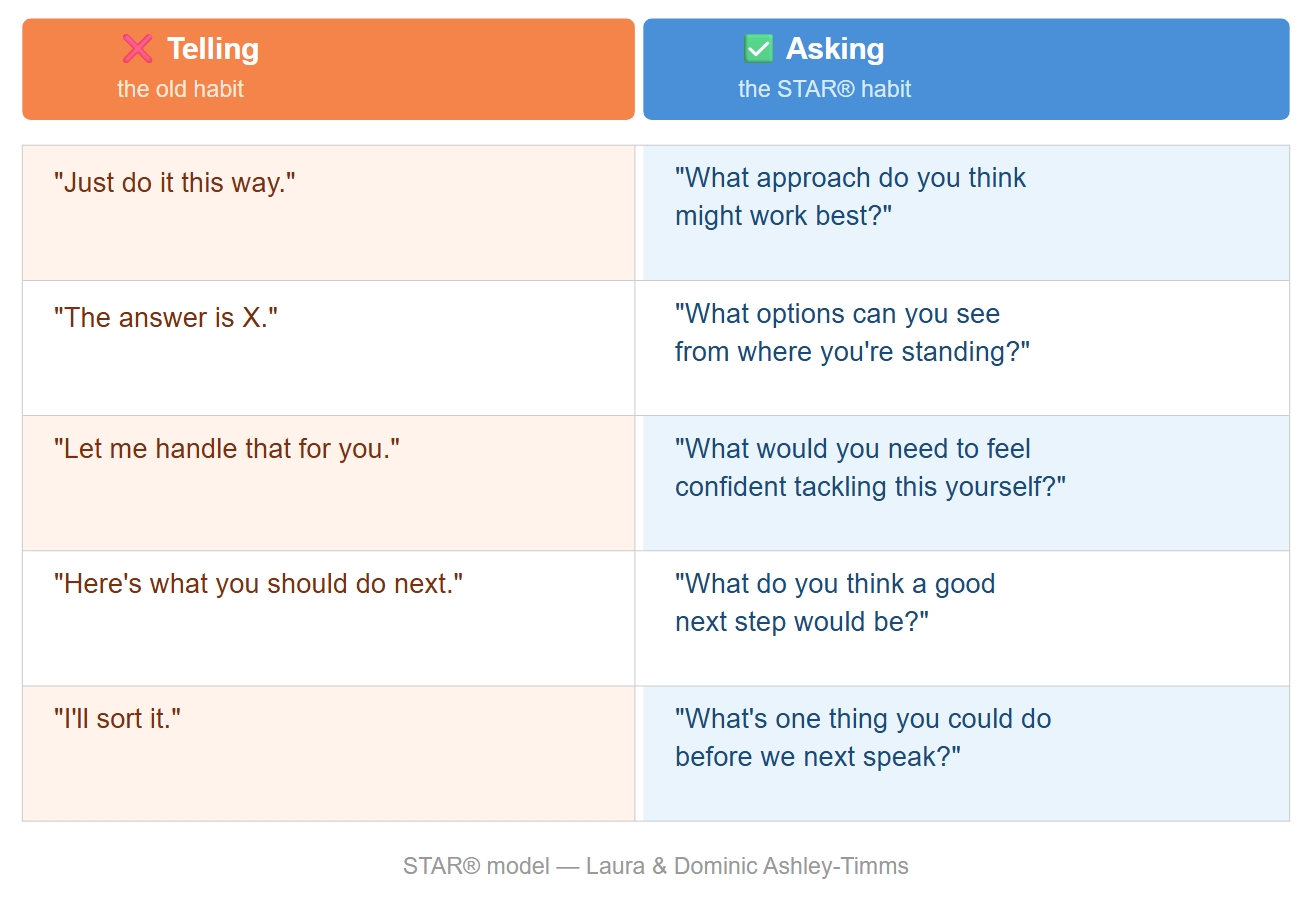
From Telling to Asking – the practical shift that brings STAR to life in your business.
“I cannot teach anybody anything; I can only make them think.” – Socrates, Greek philosopher
The hardest part of STAR is not learning the model, it’s breaking the 'telling' habit. Most managers default to telling because it feels faster, safer, and more certain.
But the long-term cost is high: teams that are dependent on you are less capable of independent thinking and less engaged.
Below is a comparison of typical 'telling' responses versus the kind of open, enquiry-led questions that STAR encourages.
Notice how each question in the right-hand column puts the thinking back where it belongs, with the other person.
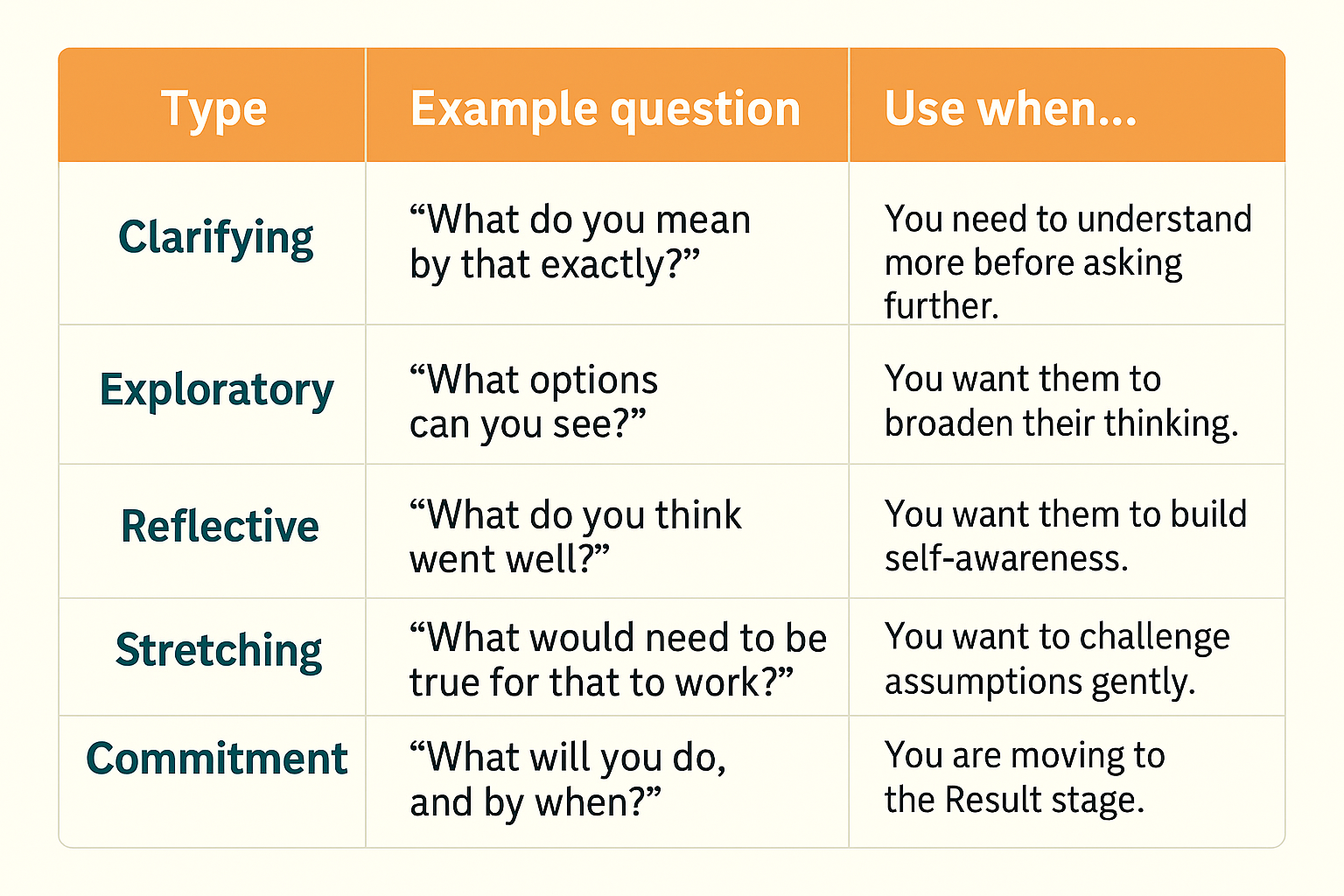
Here are 5 types of questions to help you build your STAR conversations:
Beware of a common mistake: managers often ask a brilliant question and then, because of nerves or habit, immediately follow it up with a second question, or even answer it themselves.
- Ask one question
- Then wait
- Give it time to land
The more you practice this shift, the more natural it becomes. Start small: in your next three conversations today, try asking one question which you would normally have answered yourself.
That is all. One question, three times.
Making STAR stick in your business
“For every minute spent in thought, more is gained than in hours of mere activity.” – Ralph Waldo Emerson, American philosopher and writer
Learning the STAR model is just the beginning. The real value comes from embedding it into your business, so that it becomes part of how you work, day to day. When the approach becomes habitual and woven into the fabric of how you and your managers operate each day, that is when you feel the real effects and success of the STAR model.
Here is how to make that happen.
1. Start with yourself
Do not roll this out to your team before you have tried it yourself. Commit to two weeks of personal practice. Notice the instances when you want to tell, and choose to ask instead. Keep a simple log of moments you used STAR and what happened.
2. Share the language
Introduce the STAR model to your team. You do not need to make it a big event; simply explain that you are experimenting with a different way of having conversations and that you will be asking more questions. Invite them to do the same.
3. Use it in 1-2-1s
Your regular 1-2-1 meetings are the perfect place to practice STAR. Begin each one by asking: 'What's the most important thing for us to focus on today?' Then guide, don’t direct, the conversation from there.
4. Build in reflection
At the end of each week, spend five minutes asking yourself: 'Where did I coach this week? Where did I tell when I could have asked?' This reflection is what accelerates learning and embeds new habits.
5. Celebrate the shift
When team members come to you with solutions rather than problems, acknowledge it – 'That's a great piece of thinking. How did you get to that?' Reinforcing behaviour is how you build a coaching culture.
Managing 'Moments of Truth
Here is a STOP and THINK Role Play Exercise based on the STAR Model, from the book The Answer Is a Question, by Laura and Dominic Ashley-Timms.
What the exercise is about: This is not a scripted role play. You will use a real situation from your own working life, a moment where your instinct was to jump in with the answer. The goal is to practice the first two steps of the STAR model: Stop and Think.
STEP ONE – YOUR SCENARIO – 10 MINUTES
Think of a recent moment where someone came to you with a problem, question, or decision, and your instinct was to immediately give them the answer.
Who was involved?
___________________________________________________________________________________
What did they bring to you? What did they say?
___________________________________________________________________________________
What was your immediate instinct?
___________________________________________________________________________________
What did you actually do or say?
___________________________________________________________________________________
STEP 2 – PAIR UP – 5 MINUTES
Find a partner you don't work with directly. Share just enough of your scenario for them to play the other person convincingly. Keep it brief — 2 minutes each.
STEP 3 – THE ROLE PLAY – 10 MINUTES PER ROUND
Round 1 — The Old Way
Replay the scenario as it actually happened. Give the answer. Direct. Tell. Your partner responds naturally.
How did it feel to be the manager? |
How did it feel to be the staff member? |
Round 2 — The STAR Way
Replay the same scenario from the beginning. This time:
- STOP: take a breath before you respond
- THINK: ask yourself: "What question could I ask that helps them think this through?"
- Respond with a question, not an answer
What question did you choose? |
What shifted in the conversation? |
STEP 4 – DEBRIEF IN PAIRS – 10 MINUTES
Discuss these three questions together:
- What did it feel like to stop before responding?
- How did you find your question? What was your thinking process?
- What was different about the conversation the second time?
STEP 5 – GROUP SHARE-BACK
You won't be asked to share the personal details of your scenario. You will be asked to share one insight about what you noticed in the Stop and Think process.
My one insight: |
REMINDER CARD — Keep this with you
The Old Habit | The STAR Way |
Someone asks → I answer I think: "What do I tell them?" I solve their problem | Someone asks → I STOP I think: "What do I ask them?" They develop their capability |
If you want to download this role play exercise handout and print it to use with your team, the please click the link on the button below.
The A and the R - a final note
While Stop and Think are the gateway habits, the quality of your Ask questions will deepen over time. And Result is often the most neglected step; managers have a good conversation but forget to close it with a commitment.
Always end with: 'So what will you do, and by when?' Make this non-negotiable. It is the step that turns insight into action.
The evidence: Managers who completed the STAR programme improved across nine management competencies, including communication, handling challenging conversations, and providing feedback, and identified a potential 74 times return on investment for every pound spent on the programme (LSE / Notion research, 62 organisations, 14 sectors).
And remember: the answer, in most cases, is a question.
The book and other resources
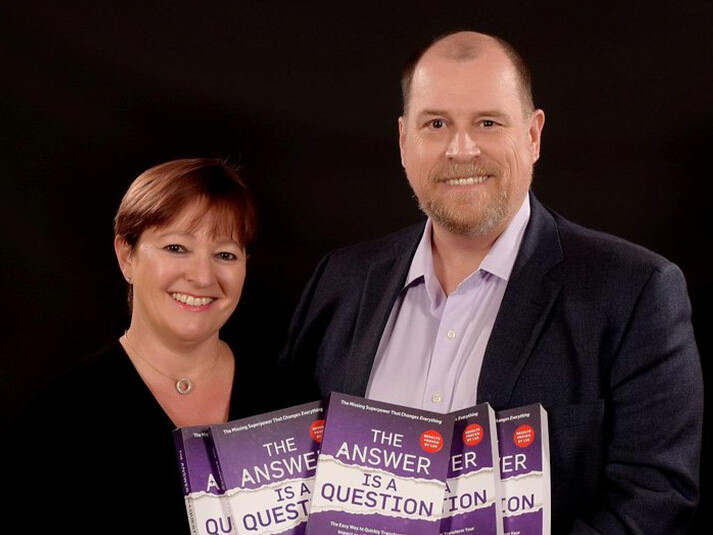
The Answer is a Question
Laura and Dominic Ashley-Timms
With ever-increasing workloads, demanding schedules, and growing instability, it’s little wonder that our stress levels are rising whilst employee engagement everywhere is miserably low. The world has changed and impacted how we work, yet our management models have not kept pace; we’re still trying to manage as we always have, by simply taking on more and more.
But what if, instead of bringing their problems to you every day, those you work with started generating the solutions themselves?
What if your team could step up and take work off you so that you got 20% of your time back?
What if making one small change could transform not only your team’s engagement levels but also your career?
In The Answer Is a Question, multi-award-winning performance consultants Laura and Dominic Ashley-Timms set out a simple approach for rehumanising the practice of management.
What people said about the book:
“Redefines the purpose of management for the 21st century.” – Matthew Syed, author, journalist and broadcaster
“For any leader or manager in business, you need this! It has truly changed the way I think about leadership, for the better!” – Nick Pointe
“I have transformed the way I communicate. One of the best investments in career learning that I’ve made. It serves as a daily guide to my success as a manager.” – Fadinding Darboe, London School of Hygiene and Tropical Medicine
If you want to dive deeper into the STAR Model, then check out this podcast – Leadership, with Darrell W. Gunter. He is joined by Dominic Ashley-Timms to discuss the STAR Manager programme, and how it can transform managers into leaders.
And here is another podcast to check out: The Remarkable Leadership, with Kevin Eikenberry.
How can simply asking better questions make you a more effective leader? Kevin sits down with Dominic Ashley-Timms and Laura Ashley-Timms to discuss moving from directive leadership towards an approach centred on inquiry. Drawing on their experience working with leaders globally, they share practical insights into how small changes in how we engage, particularly through purposeful, well-timed questions, can lead to greater team engagement, reduced burnout, and a culture of accountability.
They present the STAR model: Stop, Think, Ask, Result, as a tool for developing more purposeful leadership styles. They also explain how to establish coachable moments, highlight the importance of truly listening, and share strategies to help others develop a stronger sense of initiative and responsibility.
YOUR SUPPORT TOOLS ARE HERE:
Click the button below and you'll be able to download a PDF version of this page.