
...solve thorny business challenges in the time it takes to drink a cup of tea
How do you achieve incredible business results AND build a team for sustainable success?
Great results are, undoubtedly, the focus of your business.
And, no matter what your business does, one thing feeds your success more than anything else.
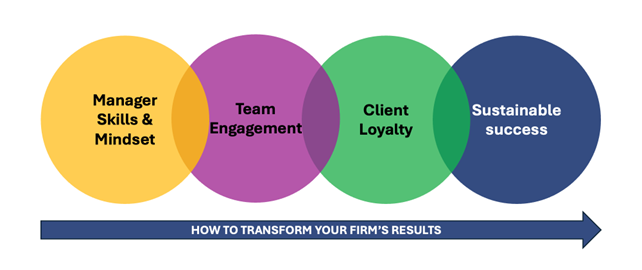
The human chain of sustainable success (above) helps show the way.
Sustainable success starts with...
…customer loyalty (or customer satisfaction). This is mission-critical.
If customers are disloyal or dissatisfied, achieving great results will be very difficult, if not impossible. You likely already know what makes your customers loyal to you. Easier still, and often a fun exercise, you can quickly work out what truly disappoints customers.
For example, in the world of accountancy, we know that:
- Responding quickly to emails and calls is much better than frustrating and unnerving delays
- Prompt delivery of your annual/management accounts is better than the loss of faith you experience because you missed out on timely business information and decisions
- Reassuring advice and certainty about your recent and future business finances and taxes beats any doubt, distrust, or misgivings, which can be unsettling and worrying
In general, all businesses must address quality, efficiency, and customer service standards to create a customer experience that fosters and sustains customer loyalty.
But how?
What drives customer experience?
What’s clear is that a disengaged team will derail delivering anything on time. They will neglect quality standards and will not properly care about your customers’ needs.
They may not fail on purpose, but the resulting customer experience from a disengaged team will be below what’s needed to achieve customer loyalty.
Put bluntly, disengaged teams harm customer loyalty and business results.
The conclusion: team engagement drives a positive customer experience and customer loyalty and, as a result, drives sustainable results for your business.
KEY FACT: The research company Gallup has studied over 3.3 million workers across 100,000+ teams globally to understand the effects of team engagement on essential business metrics.
Here are just 4 success metrics to consider:
But what drives team engagement?
Your manager skills and your manager mindset drive team engagement.
Gallup’s research and much supporting data from other studies prove that the capabilities of your managers explain 70% of employee engagement and, therefore, your resulting success.
Manager capabilities drive team engagement. Team engagement drives customer experience and customer loyalty and, as a result, also drives sustainable results for your business.
Invest time, energy, and resources in building your manager skills and mindset, and you’ll build sustainable success in your business.

@VesnaART Shutterstock ID 2526295769
Start with 5 helping hands here or read on for the full Bitesize Business Breakthrough. Use your device's back arrow to return to this point.
One thing feeds your sustainable success...
Leadership and management standards are the one thing in your business that determine sustainable success.
Improve these standards, skills, and structures, and you’ll improve team engagement, customer loyalty, and your business results.
Your leadership and management standards revolve around three types of conversations you have (or don’t have) with your team:
- 1DIRECTION conversations
- 2COACHING conversations
- 3CAREER conversations
Because manager effectiveness determines team engagement more than anything else, it’s these three conversations you must master to drive sustainable success.
Credible and proven insights
KEY FACT:
A Qualtrics 2020 Workforce study of 17,000 workers found that employees who received support from their managers recorded a global engagement score of 79%, compared with an engagement score of 23% from workers who did not receive such support.
Russ Laraway led 175 Marines as a Company Commander before his seven years at Google, during which he won the company’s Great Manager Award.
He then had a 4-year stint at Twitter. As the Chief People Officer at Qualtrics, he was able to access comprehensive research and see his approach to management transform results across a global research firm and its customers.
This Business Breakthrough report shares Laraway’s powerful manager insights about the three manager conversations you need to have to be successful.

"
“Managers, you are the keepers of engagement, and companies succeed to the extent that their employees are engaged. Better management equals better results...”
Russ Laraway, When They Win, You Win
Keep it simple
Russ Laraway’s broad and extensive experience suggests that, when you pursue these two clear outcomes, you’ll be a better manager:
- Deliver an aligned result
- Enable the success of the people on your team
The three manager conversations help you and your fellow managers and leaders deliver on these two vital business outcomes.
Three manager conversations and just 13 questions
It matters not whether you’re in retail, engineering, professional services, not-for-profit, hospitality, or accountancy – good management conversations can transform team engagement and the results your business achieves.
Thirteen well-tested questions can help you unlock the principles of team engagement. Each question signposts a set of skills that can transform your performance as a manager.
Are you willing to be brave?
Most of us are thrown into the deep end of management without the knowledge and skills training to perform as high-standard managers.
Using these questions and associated skills, you will be able to see how you stack up.
Are you brave enough to ask your team how well you perform against these 13 questions? (You’ll find the questions in a survey format in the downloadable tools link below.)
With a maximum score of 65 (5 x 13 questions), what score would your team give you as a manager?
1. DIRECTION questions:
1. How clearly does your manager communicate what is expected of you?
2. How helpful is your manager in prioritising your work, including helping you figure out what not to work on?
3. How collaborative is your manager when agreeing your individual OKRs?*
4. How collaborative is your manager when developing your team’s OKRs?*
5. How helpful is your manager in assisting you to navigate business changes that impact you and your job?
To help you better deliver against these 5 direction questions, Russ Laraway suggests that you are clear on these 4 elements:
- 1Your team’s purpose (as a function of your business purpose)
- 2Your team’s vision (as a function of your business vision)
- 3Your team’s OKRs (as a function of your business OKRs*)
- 4Your team and individual priorities (as a function of your team’s OKRs*)
*OKRs = Objective and Key Results for the next 13 weeks.
Please check out our other Business Breakthrough reports that provide greater details on ‘purpose’, ‘vision’ and ‘OKRs’.

"
““Your job as a leader is to create clarity of expectations and to be a simplifier.”
Zig Serafin, CEO of Qualtrics
2. COACHING questions:
6. How frequently does your manager solicit feedback from you?
7. How consistently does your manager provide you with specific praise for good performance?
8. How helpful is the feedback provided by your manager in improving your performance?
9. How responsive is your manager to your ideas or concerns?
10. How comfortable do you feel going to your manager with a safety concern, no matter how small?
11. How much do you agree with the following statement: “My manager cares about me as a human being?”
Recognise that there are 2 types of coaching feedback – one is easier, the other much harder!
- Continue coaching – help people understand what they should keep doing; this is easier, but rarely happens often enough
- Improve coaching – challenging people to perform better; this is harder and needs better skills. Here’s why...
‘Improve coaching’ feedback means you have a problem, and we know that humans often react emotionally to feedback.
‘Improve coaching’ feedback is often seen as criticism, and criticism as failure. Is it any wonder people often respond to this feedback with fight or flight?
Coaching can therefore be challenging. Check out the other Business Breakthrough reports on ‘difficult conversations’ and ‘crucial conversations’ for further help.
Laraway also suggests that you employ the coaching structure from the Centre for Creative Leadership, using this structure as close to the time of the ‘event’ as possible:
SITUATION: Describe the situation (context; scenario; interaction) and be specific about which work elements you are describing – facts are helpful for focus.
BEHAVIOUR: Describe the observable behaviour – it helps if you ask about their version, their story, AND that you share your version, your story. Describe how the behaviours contrast with the values and behavioural standards of your business/team. Steer clear of projecting/assuming/interpreting – what did you observe?
IMPACT: Describe what you believe to be the impact of the behaviour, including the impact on the work and on others (colleagues; customers; teams), and why this matters. Then, together, seek a solution, a new way of working, for the next work opportunity.
IMPORTANT: In most research, stories, and experiences of effective feedback, it’s vital that responsibility for the challenge/learning sits, at least partly, if not wholly, with you, the manager, and not just with your colleague.
And because the outcomes you seek are:
1. To deliver an aligned result and
2. To enable the success of the people on your team…
...you need to work together to recognise the learning and work out how to modify your own behaviour as well as theirs, to achieve the aligned result and to help your colleague succeed.
IMPORTANT: Blame is not helpful in any way; it simply ignites the brain’s limbic system to higher levels of fight/flight.
3. CAREER questions:
12. How supportive is your manager of your growth and development?
13. (Repeat) How much do you agree with the following statement: “My manager cares about me as a human being?”
Laraway provides a helpful structure which you can adapt and adopt for your team to build your skills on these two career elements.
Caring about careers within and beyond your business proves you’re on your people’s side and can accelerate their engagement in the work you do together. These simple but powerful elements help you do this:
- Start with the past – focus on key decisions/times/transitions and what these mean to them in order to establish their motivations, fears, and values
- Talk about the future – find out the career pinnacle at which they’re aiming
- Plan for the present – together, work out a relevant and thoughtful plan with clear timelines and explicit owners for each action (them/you/others)
STOP expecting your managers to ‘guess’ how to be good managers
START seeing your manager skills as the magic sauce that helps build team engagement and customer loyalty, which will improve your business results
Cadence and structure is key...
These 13 questions help you focus on specific things you can do to improve your manager knowledge and skills. But when do you use them?
To help you, please consider the structures you need to put in place to help you and your team.
Diary time is your most influential structural support. What blocks of time do you want to allocate to structured discussions that result in your getting high scores on all 13 questions? How frequent should these manager blocks of time be set up?
DIRECTION: As guidance, direction conversations are going to be daily or weekly, depending on seniority and experience and team dynamics. Everyone wants to succeed, and the natural working cadence is daily and weekly. Tap into this natural cadence and you’ll better help your team see clearly what’s expected.
COACHING: These conversations should take place as events happen, or as close to them as you can make it. Think about a gymnast trying to master a complex floor routine or vault. They’d expect feedback and coaching immediately after they finished, not at the end of the week!
CAREER: An annual conversation does not demonstrate genuine care. Half-yearly or quarterly structured formal career conversations that fit with the OKR cycle make sense. Reference their career ambitions when discussing direction and coaching whenever the opportunity presents itself.
Here's the proven solution for you...
Use the three conversations – direction, coaching, and career – to influence how you manage. Work on improving your scores against the 13 questions of an effective manager and you’ll improve team engagement, customer loyalty, and your business success.
Click here to read this whole Bitesize Business Breakthrough . Use your device's back arrow to return to this point.
TIME TO DISAGREE
“Thirteen questions are a lot to take in when we have so much on our plate already.”
You’re right to want to avoid initiative overload by tackling all 13 question areas at once.
Instead, look at the 3 categories of questions – DIRECTION, COACHING, CAREER – and focus on one of these areas. And, if it feels right, isolate 1 or 2 questions that you think, if you improved them, you’d get the easiest, quickest positive result.
“Our people just want to do their job well; having managers interfere can be unhelpful and counterproductive.”
When unskilled managers ‘interfere’, it’s not surprising that the results fail to improve; you’re right to be hesitant.
This is why Laraway and his experiences in the Marines and at Google, Twitter, Candor Inc, and Qualtrics all point to improving manager standards and manager capabilities.
And because these revolve around better manager conversations, you and your fellow managers can, with improved structures and an understanding of cadence, become better at managing, building team engagement, and improving customer loyalty – allowing you to enjoy the subsequent success you seek.
ULTIMATE ARGUMENT
"How do I know this will work for me and my business?"
Gallup, Qualtrics, McKinsey, and many others report on the important connection between team engagement and business success. And common sense suggests that, if you have a disengaged team, the timeliness, quality, and care around what you do will not satisfy customers and you’ll struggle as a business.
What harm can come from sharing these insights, taking the questionnaire, and working on manager skills? It’s worth it, don’t you think, to work with a handful or one or two colleagues to improve your manager effectiveness using Russ Laraway’s proven insights?
Four helping hands for you...
As a manager, you can influence the success of your people and your business every day through the conversations you have with them.
Improving your manager skills helps you ‘deliver an aligned result’ and ‘enables the success of the people on your team’.
These ‘4 Helping Hands’ can get you started:
1
Actively seek ways to improve the structure, regularity, and content of your conversations with your team.
2
On a daily or weekly basis, help everyone in your team see clearly what’s expected of them.
3
Seek out regular opportunities to coach your people. Recognise behaviours and performance you want to keep and repeat, and seek out opportunities to help your people improve and succeed even more.
4
Be deliberate about 13- or 26-week career conversations that reflect on your people’s past and future goals and current plans.
We’ve allowed ourselves to fall victim to this idea of grandiosity - that leadership is better than management. We focus on the esoteric, complex ideas that make us a ‘leader’ rather than the specific things managers must do well.” – Russ Laraway, When They Win, You Win
Tell me more?
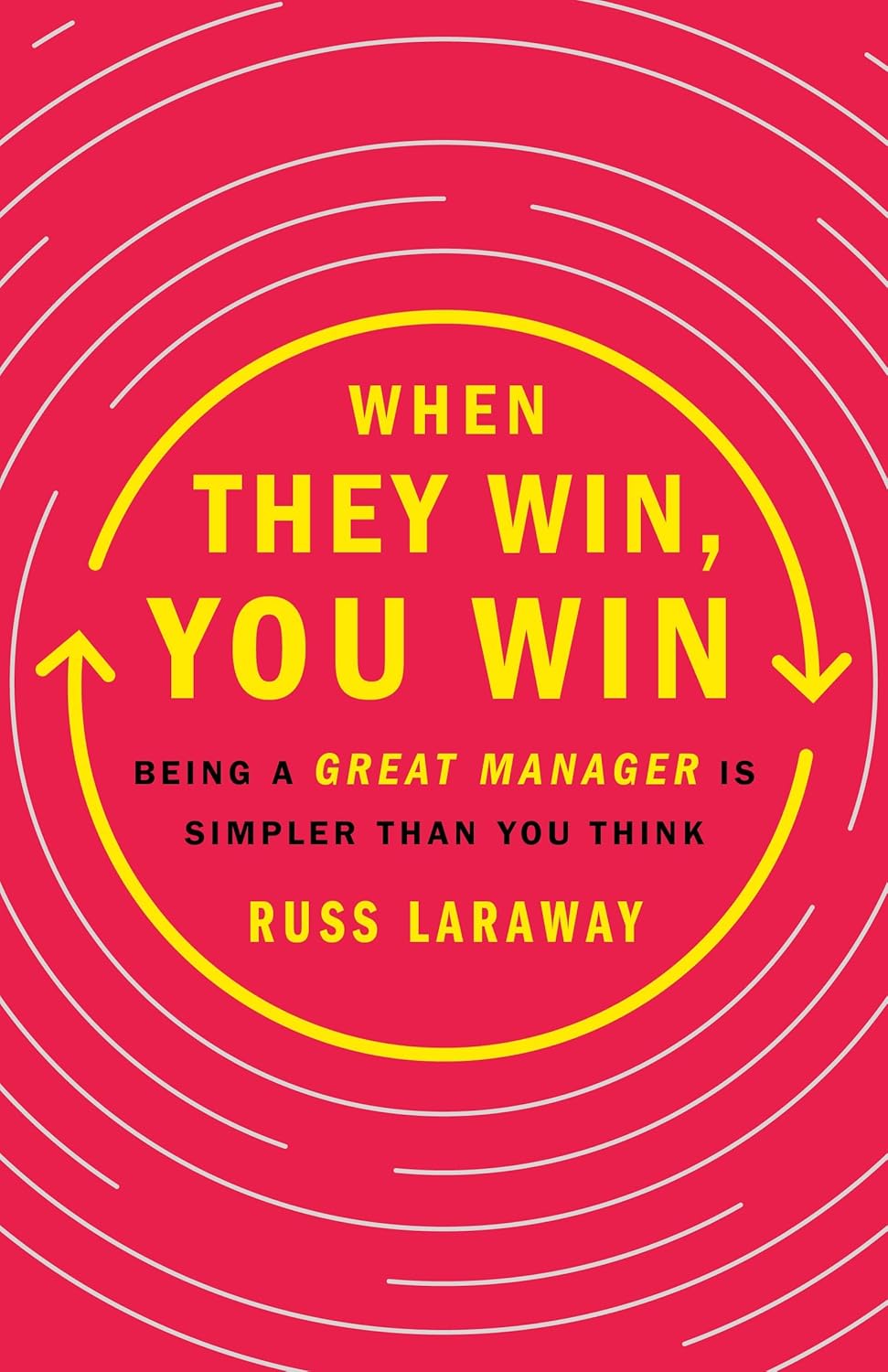
When They Win, You Win
Russ Laraway
This book takes the doubt out of what it takes to be a great manager and achieve great results with your team.
“This book unlocks a simplified, coherent management approach that reliably delivers
engaged results... you really need to read it.”
– Dick Costolo, Former CEO of Twitter
Laraway streamlines how to achieve the results you seek by outlining three key conversations: giving direction, coaching for improvement, and discussing careers to show genuine care.
We suggest you devour the details in Laraway’s book to enhance your skills and results as a manager.
YOUR SUPPORT TOOLS ARE HERE:
Please use these tools and resources to help improve your own skills and those of your managers to build team engagement, customer loyalty and success for your business.

