
...solve thorny business challenges in the time it takes to drink a cup of tea
What if every manager and leader could reclaim 10%, 20%, or even 40% of their working week?

©FreePik
If you were able to release a half day (10%), a day (20%), or even two days (40%) per week, you’d be able to transform your results as a manager and, in the process, transform your business results and accelerate your career.
But there are a few challenges holding managers and leaders back from higher performance and better results:
1. LACK OF TIME – Ask anyone in a leadership or management role if they have spare time every week, and you’re likely to have them climbing down your throat! Despite the technological advances we all use, most managers find that they are time-poor.
2. LOW TEAM ENGAGEMENT – Employee surveys such as the Gallup Q12 Team Engagement Survey show team engagement from UK employees at just 10%. Just think, we could be tapping into 90% more engagement from our people!
3. THE PETER PRINCIPLE OF INCOMPETENCE – According to the UK Chartered Management Institute (CMI), 82% of managers are promoted to management based on their ability to do their job rather than on their ability to lead and manage. They are 'accidental' managers, promoted into management levels until they reach a level of incompetence!
The macro impact of these shortcomings, according to the CBI in a 2019 report called ‘Great Job’, is £110billion in productivity across 5.5million businesses in the UK.
And all we need to do, say the CBI, is improve manager skills and capabilities by a modest 7%.
Whether you manage one person or a hundred, this report can help you and your fellow managers and leaders get your hands on this 7% improvement.
The payoff can be transformative when you improve your manager skills and habits.
If you don’t grow your people, you will not grow your results. Your progress requires their progress.
Use informal manager moments (interruptions!) by your team to STOP and THINK about how these moments can help your people grow their knowledge, skills, and habits.
When you do, you’ll be investing in their future. And, as a result, they’ll do more, to a higher standard, more often, without bothering you as much. You’ll get some time back and drive performance up.
But managing is a tough gig...
A. New technology is coming at us at an ever-increasing rate, and now we have the challenges of AI to deal with as well.
B. Five generations of workforce each have their own unique ‘styles’ and expectations – Traditional; Baby Boomers; Generation X; Generation Y; Generation Z.
C. The half-life of knowledge – the time it takes for half your knowledge to become obsolete – continues to drop, thanks to the expansion of research and the accessibility of new and up-to-date insights.
D. And now we have to manage hybrid working, with each team member seemingly needing a unique arrangement.
So what can you change?
Rather than attempting to change the things you can’t control, focus instead on changing your own behaviours, skills, and habits.
As Leo Tolstoy once wrote:

“Everyone thinks of changing the world, but no one thinks of changing themselves.”
Leo Tolstoy
Pushing water uphill is tough...
…and changing yourself is easier said than done!
Change is often difficult because our daily behavioural habits, our language habits – in fact, all of our habits – are hard-wired into our brains.
This is normal for humans. The brain has evolved to hard-wire our habits automatically to make life easier. The downside is that it makes change challenging.

©FreePik
For example, have you ever gone from your normal manual gearbox car to an automatic?
This small change often results in a very fast hard stop when both feet hit the brake! Your old habits have you trying to brake and depress the clutch as normal, but in the automatic car this results in a drastic two-footed braking experience!
Or have you ever reorganised your kitchen drawers and then repeatedly opened the drawer that used to have the teaspoons in?
‘Old habits die hard’, they say – or rather, old habits NEVER DIE!
You need new habits that will be stronger than the old ones.
Be clear – your habits dictate your results, and so it pays to...
...better manage those manager moments
The Peter Principle, the CMI report, and the CBI report mentioned earlier suggest that managers’ behaviours and habits need to change. Improving our manager abilities will lead to an improvement in manager results.
We all work with our teams in two settings:
- Formal – 1-to-1 sit-down sessions, team meetings, daily huddles, quarterly updates
- Informal – those day-in, day-out interactions that help team members get jobs done
Both are designed to help you and your team achieve the results you seek. In formal settings, the agenda you use and the KPIs on which you focus bring structure and form and help you to be an effective manager.
But what about all those informal 1-on-1 conversations with your people?
And what about the questions you’re asked in the formal manager settings?
These questions, issues, and challenges happen many times a day, every day.
Improve the structure and content of these conversations, and you can manage and lead your team for better results.
Start quickly with 4 helping hands here or read on for the full Bitesize Business Breakthrough. Use your device's back arrow to return to this point.
What's holding you back?
It pays to acknowledge what’s getting in our way:
1. Not enough time...
There’s that time excuse again! We all have the same 24 hours a day, whether we’re an Olympic gold medallist, Elon Musk, or any other successful person on the planet.
Therefore, we should conclude that changing how we use time will enable us to change our results.
2. Too many things on the go at once... and more coming
Quality issues and improvements need managing. Delayed work needs resolving. Customer challenges need your attention. You need to work around team absences. Unexpected work throws your plans out the window.
The sheer amount of work, responsibilities, and expectations brings variety but challenges your focus and your productivity.
You need your team to take more from you. You need to be better at delegation. You need more initiative from your people.
3. Too many interruptions...
Because of the variety of work, you often feel like a ball in a pinball machine. You may get to the end of your working day and wonder what exactly you’ve achieved.
If this becomes a repeating pattern, you might even question whether you’re in the right role!
However, if you change your behaviours, you’ll be in a better position to unlock the engagement, productivity, and performance of the people around you. You’re in control of yourself, so it’s entirely possible you can change and become a stronger, standout, star manager.
Let’s start with how you see yourself as a manager, as this profoundly influences your ability to take on new behaviours and build new habits.
What's your primary role as a manager?
Whenever we ask managers and leaders this question, one of the most common answers is always:
‘I solve problems.’
Isn’t that what managers are paid to do – fix problems?
Partly, yes. But you want to be less stressed, less time-constrained, prouder of the work, and achieving greater results.
Your view of your role is key. What if you could see yourself as someone who helps your team solve their own problems?
‘I help my team solve their own problems.’
Can you hear the ‘yeah, but...’ bubbling in your throat?
- They’re too inexperienced!
- They’re not motivated enough!
- They’re not capable!
But what if you could, in those small moments of manager truth, shift from problem solver to problem solver coach? If you don’t, your team won’t grow, you won’t improve your results, and you won’t free up precious time, time that could help you and your team succeed.
Your attitude to interruptions matters.
How do you feel about interruptions from your team?
Are interruptions by your people a problem or an opportunity?
In reality, they are both. However, we usually just want the problem to go away as fast as possible. And so we either fix the problem for our colleague or help them fix it without much input from them.
As a result, the next time your colleague runs up against a problem, they will expect that you’re the one who will fix it.
What if every interruption by a colleague was a coaching moment, an opportunity to help them solve their problem themselves?
Do this often enough, and what will happen? They’ll start thinking more independently, coming up with suggestions, and they'll eventually sort out their problems without bothering you.
Where do you start?
Oddly enough, you ‘start’ by triggering yourself to STOP.
Laura and Dominic Ashley-Timms share a 4-part STAR model for better managing the many manager moments you face every day.
The model has been assessed through comprehensive research by the London School of Economics, working with 62 organisations in 14 sectors. The LSE conclusively demonstrates tangible and measurable improvement in manager skills and results. The depth of research is impressive, and the model can be quickly learned.

©FreePik
The STAR model is a practical framework to help managers shift from a directive, telling style to a coaching, questioning style.
4 star manager steps...
STAR – STOP, THINK, ASK and RESULTS
This report focuses on the first two elements – STOP and THINK – which form the essential foundation of the model.
These two steps help you escape your problem solver habits. Without them, you’ll revert to doing what you’ve always done (old habits never die, so make your new habits stronger).
You’re in total control of the first two steps. Nobody else is involved until you get to Steps 3 and 4.
S – STOP

Step back. Change your state.
Someone comes to you with a problem. Your automatic instinct is to solve it, quickly.
Instead, STOP.
Interrupt your natural instinct to help fix things.
Use this urge to solve their problem as a trigger to win a bigger game – the opportunity to grow your people’s knowledge and skills. In time, this approach will help your people grow and succeed and will help make you a better, more successful manager.
A physical pause is your key to unlocking more effective management – just two seconds will do! Take a breath. Create a small gap between the problem arriving and your response.
Only when you actively stop – preventing yourself from stepping into the problem – do you create a powerful opportunity to begin developing your team.
Without this pause, every other step in the model is impossible. The habit of solving is simply too fast.
In practice: When someone brings you a problem, notice the pull to answer immediately. That pull is your signal. Don't act on it yet. Apply the brakes and simply STOP.
You can then take Step 2...
t – think

Ask yourself a question.
Once you've stopped, use the pause to ask yourself one quick question:
‘Does this person already have what they need to work this out themselves?’
You stopped. You interrupted your typical response, even when under pressure.
You set yourself up to change outcomes for you, your colleague, and your business.
This step is where better management happens.
Most of the time, the answer will be yes. Your team member probably has more capability than either of you is giving them credit for. The question is whether you're about to shortcut their thinking and their progress – or support it.
If it truly is an emergency or a complex technical matter only you can resolve, then answer. But be honest with yourself about how often this is really the case.
Why not ask yourself:
‘Is this genuinely urgent, or does it just feel that way?’
‘What would they learn if they worked through this themselves?’
‘How can I help them work this through?’
‘What’s the best question I can ask now to help my colleague think?’
In practice: Get into the habit of running this mental check every time someone comes to you. It takes seconds. Over time, it becomes automatic – and it changes everything that follows.
Here's the proven solution for you...
When presented with a challenge, problem, or issue by one of your team, STOP going straight in to ‘fix-it’ mode. Yes, you can do this if you want, but you’ll miss out on the opportunity to grow your team member’s knowledge, skills, and habitual behaviours.
Instead, THINK about what questions you could ASK that result in your team member thinking about and contributing to the fix.
Less is more...
Use your device's back arrow to return to this point.
STOP : thinking you are the only one who can solve the problems in your business
START : triggering yourself to STOP
4 helping hands for you…
As a manager, you can influence the success of your people and your business every day if you take seriously the STAR framework – especially the STOP and THINK stages.
These create the gap, the space, the opportunity you need to ask better questions rather than simply fix everyone’s issues yourself.
These ‘4 Helping Hands’ can get you started:
1
Instead of seeing yourself as a problem solver, see yourself as a catalyst for helping your colleagues solve their own problems.
2
See every interruption by a colleague as an opportunity to help them (rather than simply fixing their issue yourself).
3
Use your natural, automatic, deep-seated desire to resolve your colleague's issue quickly as a trigger to STOP.
4
THINK about the best question you can ask yourself in that moment before working out what question to ask your colleague.
TIME TO DISAGREE
“It almost seems too simple to be worth the effort...”
You’re right, the 4-part framework of STAR – Stop; Think; Ask; Result – seems almost too simple for words. And yet it needs to be simple if it's going to help you break entrenched old habits and allow you to establish the new habits that will deliver the results you want for yourself, your team, and your business.
Just use the stop triggers, cues, or prompts you've created for yourself so that you create a little bit of space, space in which you can think about whether you dive in to resolve the problem or ask a question to help build the knowledge, the skills, and the habits of your team members.
When you grow your team’s knowledge, skills, and habits using the STAR framework, you grow their ability to deliver greater results and save you time.
“We’re always in a rush. Taking time to help the team improve means we’ll use more time, which we don’t have.”
Your challenge is understandable and not uncommon.
However, unless we use a couple of minutes here and there to stop and think, nothing will improve. Change nothing, and the demands on your time will increase.
If all that this takes is a few more minutes, here and there, plus a focus on helping your people improve (rather than helping them by giving them the fix), you create an opportunity to improve your team's knowledge, skills, and habits.
Over time, your results will improve, and you’ll claw back precious time that was previously consumed by ‘people problems'.
ULTIMATE ARGUMENT:
“How do I know it will work for me and my business?”
The independent research by the London School of Economics, working with 62 organisations in 14 sectors, demonstrates tangible and measurable improvement in results.
Productivity and staff retention measures showed genuine improvement in 6 months, following the implementation of the STAR manager skills approach.
Want to know more?
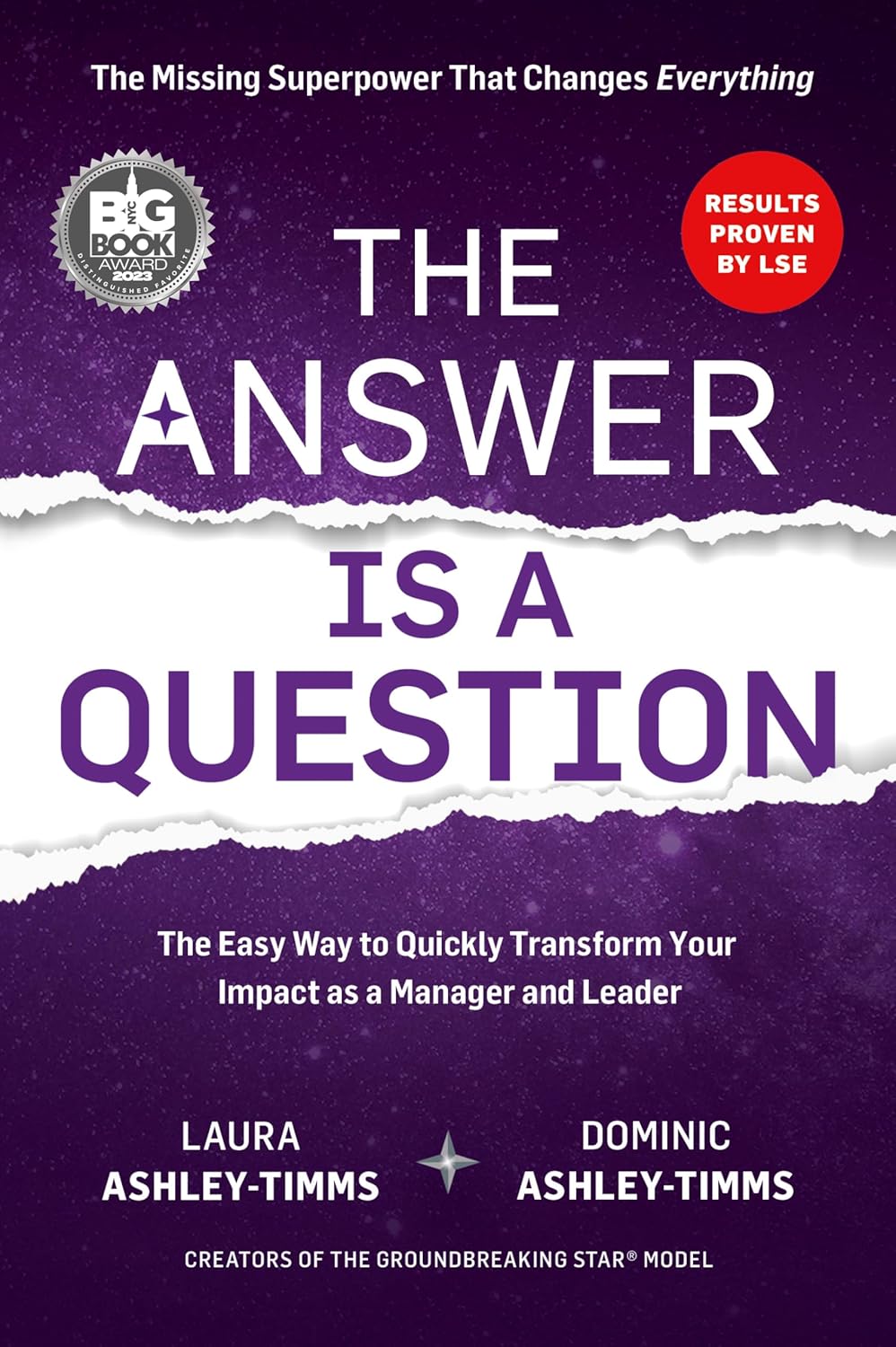
The Answer is a Question
Laura and Dominic Ashley-Timms
The book’s title – The Answer is a Question – is, in itself, a prompt that helps you discover a better way to manage and lead your people.
Laura and Dominic Ashley-Timms have captured a methodology that works. The independent research by the London School of Economics has proven that the STAR model delivers measurable results. It can almost certainly help you and your team improve results as well.
We suggest you dive into and soak up the many practical insights in their book, The Answer is a Question.
Enter your text here...
YOUR SUPPORT TOOLS ARE HERE:
Use these tools and resources to help improve your own skills and those of your managers to build team engagement, customer loyalty, and success for your business.
Find the support tools to help you
These two steps alone — before you've said a single word — represent the most significant shift in the entire model.
By encouraging managers to STOP and change state, then THINK about their approach in the moment, it creates the opportunity to ASK questions that support the learning of another.
Everything that makes a coaching conversation powerful starts here.

© Remarkable Practice Ltd 2020 - All rights reserved