
...solve thorny business challenges in the time it takes to drink a cup of tea
Could your team’s mindset be the biggest obstacle to your business growth?

©Magnific
To improve their business, most leaders spend time examining systems, processes, products, and people.
Far fewer stop to examine the beliefs that drive behaviour.
Yet mindset sits behind every decision, every response to feedback, and every reaction to change.
When people believe their abilities are fixed, they often avoid challenges, try to protect their reputations, and become defensive when things go wrong.
However, when people believe they can learn, they are more willing to stretch themselves, seek feedback, and experiment with new approaches.
In a world where change is constant, creating and nurturing a learning mindset can have a remarkable impact on your business performance.
A fixed mindset works against you. It chips away at your ability to win. A growth mindset does the opposite – it sets you up to succeed.
Research published by Talent LMS in 2024 found that:
- 88% of senior leaders believe a growth mindset is important for business success
- 80% believe a growth mindset contributes directly to profit growth
- 89% believe future business success will depend on leaders who embody a growth mindset
Believe that your abilities can be developed and improved – rather than thinking you're born with fixed levels of intelligence, character, skills, and creativity – and you're much more likely to succeed. Nurture this growth mindset and see it work for you and for everyone else in your business.
Toyota sets the standard...

@magnific
Long before growth mindset became a fashionable business concept, Toyota built a global reputation around Kaizen, the philosophy of continuous improvement.
Kaizen is built on a few simple principles:
- Everything can improve
- Every process can become better
- Every employee can contribute ideas
- Every mistake teaches something useful
Over time, the accumulation of small improvements creates extraordinary results.
That philosophy has positively influenced businesses around the world because it recognises that sustainable success rarely comes from one big breakthrough.
More often, it comes from hundreds of small improvements that compound over time.
A growth mindset is the Kaizen of personal and professional development:
- Instead of asking who is to blame, growth-minded people ask what can be learned
- Instead of avoiding mistakes, they examine mistakes for insights
- Instead of defending themselves, they improve themselves
Microsoft sets the modern standard
One of the most compelling modern examples of growth mindset in action comes from Microsoft. When Satya Nadella became CEO in 2014, he inherited a respected company that was struggling to regain momentum. Internally, many people described the culture as highly competitive. Teams often focused on proving they were right rather than on learning together.
Nadella drew heavily on Carol Dweck’s work and championed the idea that Microsoft needed to shift from a know-it-all to a learn-it-all culture.
This became one of the defining themes of his leadership. From 2014, Microsoft experienced consistent revenue growth and a 10x valuation growth over 12 years.
In his book, Hit Refresh, Nadella argues that long-term success depends on maintaining curiosity.
He repeatedly emphasises learning, empathy, and adaptability. Instead of rewarding people for having all the answers, he encouraged them to ask better questions.
The idea sounds simple, but it transforms behaviour:
- Employees become more willing to collaborate
- Leaders become more interested in coaching
- Learning becomes a source of competitive advantage
Nadella also links growth mindset to empathy. He argues that leaders who stop learning also stop understanding customers:
- Curiosity creates understanding
- Understanding creates innovation
- Innovation creates growth
Microsoft’s remarkable transformation demonstrates that a growth mindset is not simply a personal development concept. It can become a strategic business philosophy.
When learning becomes embedded in culture, businesses become more resilient, innovative, and adaptable.
Talent versus learning...
Have you ever heard someone say, “I’m not creative” or “I’m not good with technology” or “I’m not a natural leader” or “I’ve never been good with numbers”? These are examples of a fixed mindset.
We may even have said similar things ourselves. These statements feel factual and concrete. But in most cases, they reflect assumptions, history, and perception rather than reality.
The reality is that very few, if any, business skills arrive fully formed. People learn to lead, to negotiate, to coach, to communicate, to analyse, to use new technology, to present, and to change.
Nobody starts as an expert
In fact, behind almost every successful businessperson sits years of committed learning, getting it wrong, practice, feedback, and experience.
A fixed mindset tells us that talent determines success.
A growth mindset tells us that talent may play a part, but learning determines how far we travel.
This is why some individuals continue developing throughout their careers while others stop progressing long before they reach their potential.
Carol Dweck’s pioneering research and her book, Mindset, transformed the way many people think about performance and development.
Dweck’s work demonstrates that people who believe improvement is possible are more likely to succeed. They embrace challenge, persist through setbacks, and learn from criticism.
What makes Dweck's research especially important is her discovery that, for some leaders, mindset becomes contagious. Whether you choose a fixed or growth mindset, your team will generally follow.
Teams pay attention to what leaders recognise and reward:
- If leaders encourage learning, experimentation, and development, those behaviours increase.
- If leaders reward perfection and punish mistakes, people become more cautious.
Modern research continues to support the principle that beliefs influence behaviour. More importantly, recent research highlights that a growth mindset is most effective when combined with a supporting culture.
Businesses cannot simply tell employees to adopt a growth mindset. They must create conditions where learning is encouraged, supported, and recognised.
Every adult is a learner - the DVLA show us the way...

@magnific
One of the best examples of a growth mindset remains surprisingly ordinary – learning to drive.
Millions of people learn to drive despite making mistakes, stalling, missing junctions, and occasionally failing tests. Nobody expects mastery on day one.
Driving instructors expect mistakes because mistakes are part of learning.
Learners expect corrections because corrections are part of progress.
Most people continue practising because they believe improvement is possible.
Imagine applying that same logic to leadership, public speaking, sales, or technology.
Instead of avoiding challenges, people would approach development with patience and persistence. They would accept that competence comes after practice rather than before it.
There are more examples of this in the supporting tools to accompany this Business Breakthrough report, including proof that anyone can learn to draw…
STOP defending old assumptions, avoiding feedback, and assuming that talent matters more than development.
START embracing challenge, encouraging learning, sharing lessons, and creating a culture where improvement is valued.
It turns out Henry Ford was right all along...
The man who built the Ford Motor Company famously said: “Whether you think you can, or think you can’t, you’re right.”
This statement is not about wishful thinking; it’s about a growth mindset.
- If people believe that improvement is impossible, they stop trying.
- If they believe that improvement is possible, they continue learning.
Belief alone will never guarantee success. However, belief influences effort, persistence, and resilience. These factors shape the actions and behaviours that ultimately determine results.
Proof on a larger scale...
The largest mindset study ever run, the National Study of Learning Mindsets, tracked almost 12,500 teenagers across 65 US schools. Two 25-minute online sessions on growth mindset were enough to lift grades among lower-achieving students, and to push more of them into advanced math classes.
The workplace tells a similar story. Researchers surveying employees across seven Fortune 1000 companies found that people inside growth mindset firms were 49% more likely to say their business genuinely fosters innovation, and far less likely to report colleagues cutting corners or cheating to get ahead.
Mindset isn’t just a soft add-on. It’s a genuine performance lever.
Growth Mindset - the key question to ask...
@shutterstock_2679520503
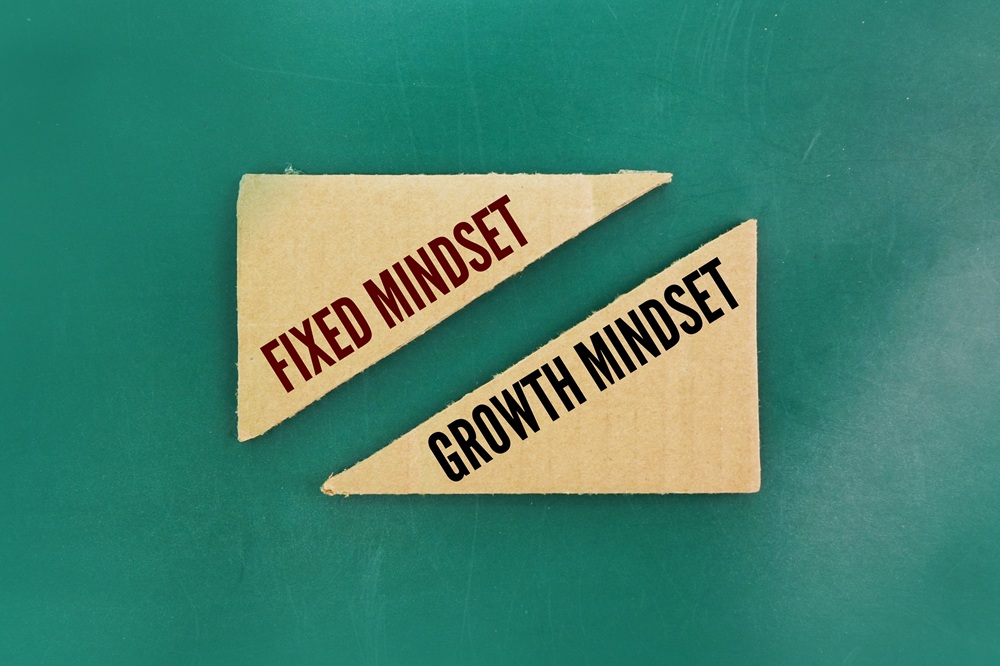
A simple question: Do I believe intelligence, skill, creativity, and leadership ability can be cultivated?
If your answer is yes, you are moving towards a growth mindset. If your answer is no, your fixed mindset may be limiting your potential.
The purpose is not to eliminate a fixed mindset. We all experience fixed mindset thoughts from time to time. The objective is to recognise fixed mindset thoughts and to respond differently.
When does it really matter?
There’s a specific moment where your mindset really earns its keep.

“It kicks in the instant we hit a struggle or a challenge. How we read that setback shapes whether we stay engaged with the task in front of us. Disengage, and we lose all the mental benefits that come from actually working through the difficulty.”
Dr Carol S. Dweck, Mindset

“The tougher it gets, the more you need your growth mindset in the driving seat – not the limiting, fixed one.”
Satya Nadella, Hit Refresh
Start quickly with 4 helping hands here or read on for the full Business Breakthrough. Use your device's back arrow to return to this point.
Stack the odds in your favour...
Dweck, Nadella, and the wider research community have identified several ways to tip the odds in your favour. Lean more towards growth rather than fixed, and success tends to follow.
Step one is accepting that both mindsets live in all of us…
1. Hear your fixed mindset voice
Avoiding or ignoring your fixed mindset means you’ll never achieve maximum potential for yourself or for your business. We all have both mindsets at play – we are human, after all.
Accept and acknowledge the existence of a fixed mindset. You can then enter into a
dialogue that moves you, your people, and your business to a greater use of a growth mindset and the better results that will follow.
Check out the downloadable tools which include scripts showing you how to handle this dialogue at your point of challenge.
2. Remember, you have a choice
How you read a challenge, a setback, or a piece of criticism is entirely a choice.
Read it through a fixed mindset, and any difficulty encountered seems to confirm that your talent or ability simply isn’t there.
Read the same difficulty through a growth mindset, and it signals that you need to learn more, push harder, and stretch your capabilities.
So, when challenges, setbacks, or criticism land, you’ll hear that fixed mindset voice first, and then…
3. Talk back with a growth mindset voice
Right at the moment of challenge, the fixed mindset says: “Are you sure about this? Maybe you just don’t have what it takes.”
The growth mindset answers: “I might not be able to do this yet, but I can learn to, given time and effort.”
Then...
4. Take the growth mindset action
Over time, whichever voice you listen to most becomes your default. That shows up in whether you:
- Throw yourself fully into the challenge
- Treat setbacks as information, and go again
- Act on the criticism
Learn how to notice both voices and practice choosing to act on the growth mindset voice.
More than 42 million driving license holders are living proof that everyone has a growth mindset in them somewhere.
Both mindsets show up daily; the trick is acknowledging that, rather than denying it.
Success depends on choosing the growth mindset the moment that obstacles, criticism, or difficulty show up.
TIME TO DISAGREE
“What if my people say they have a growth mindset but are still reluctant to learn?”
Words are easy, but behaviour tells the truth. People with a genuine growth mindset demonstrate curiosity, seek feedback, and remain open to development. Focus on behaviour rather than on declarations.
“What if one of my team is trying really hard but still failing?”
Effort matters, but effort alone is rarely enough. Better learning methods, stronger coaching, improved processes, and more deliberate practice are often required. Growth mindset is not about trying harder forever. It is about finding better ways to improve.
“Isn’t growth mindset simply all about the power of positive thinking?”
No. Positive thinking says everything will be fine. Growth mindset says improvement is possible if we learn, adapt, and act. One is optimism, the other is development.
ULTIMATE ARGUMENT:
“How do I know growth mindset will deliver better results for my business?”
Because every business depends on its ability to learn.
Markets change, customers change, technology changes, competitors change.
The businesses that thrive are rarely those that know the most. They are often those that learn the fastest.
Toyota’s Kaizen philosophy and Microsoft’s transformation under Satya Nadella point towards the same conclusion. Continuous improvement creates sustainable advantage.
4 helping hands to get you started…
1
Hear your fixed mindset voice. Recognise the internal dialogue that encourages limitation.
2
Remember, you have a choice. Choose learning rather than judgement.
3
Talk back with a growth mindset voice.
Replace “I can’t” with “I can learn”.
4
Take the growth mindset action.
Progress comes from action, reflection, and improvement.
Want to know more?
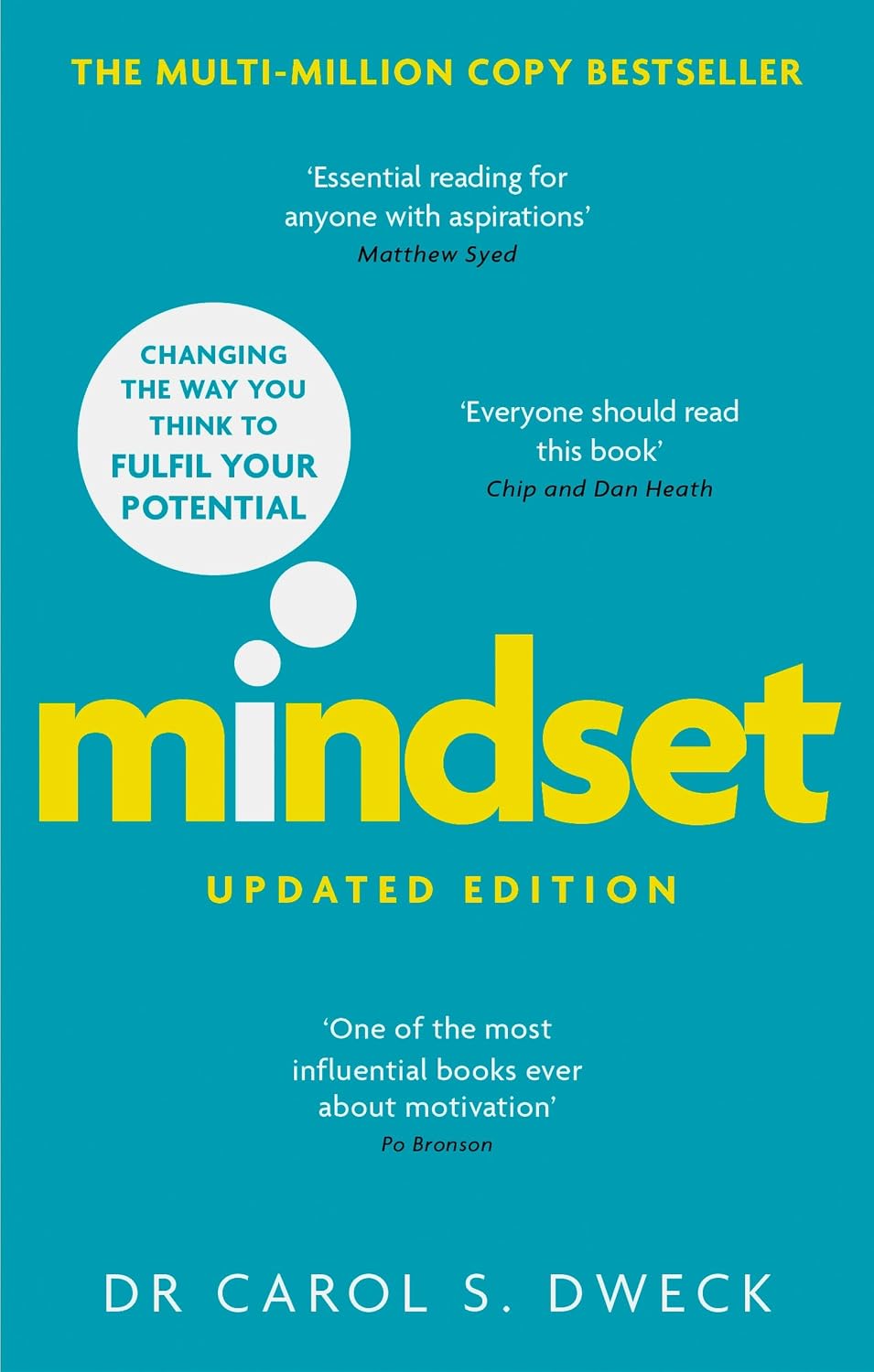
Mindset
Dr Carol S. Dweck
This book remains essential reading for anyone wanting to understand the difference between fixed and growth mindsets. Dweck’s ideas have already been built into the UK schooling system.
Elite sport and business have followed suit. The evidence behind growth mindset is compelling and well worth exploring further for yourself.
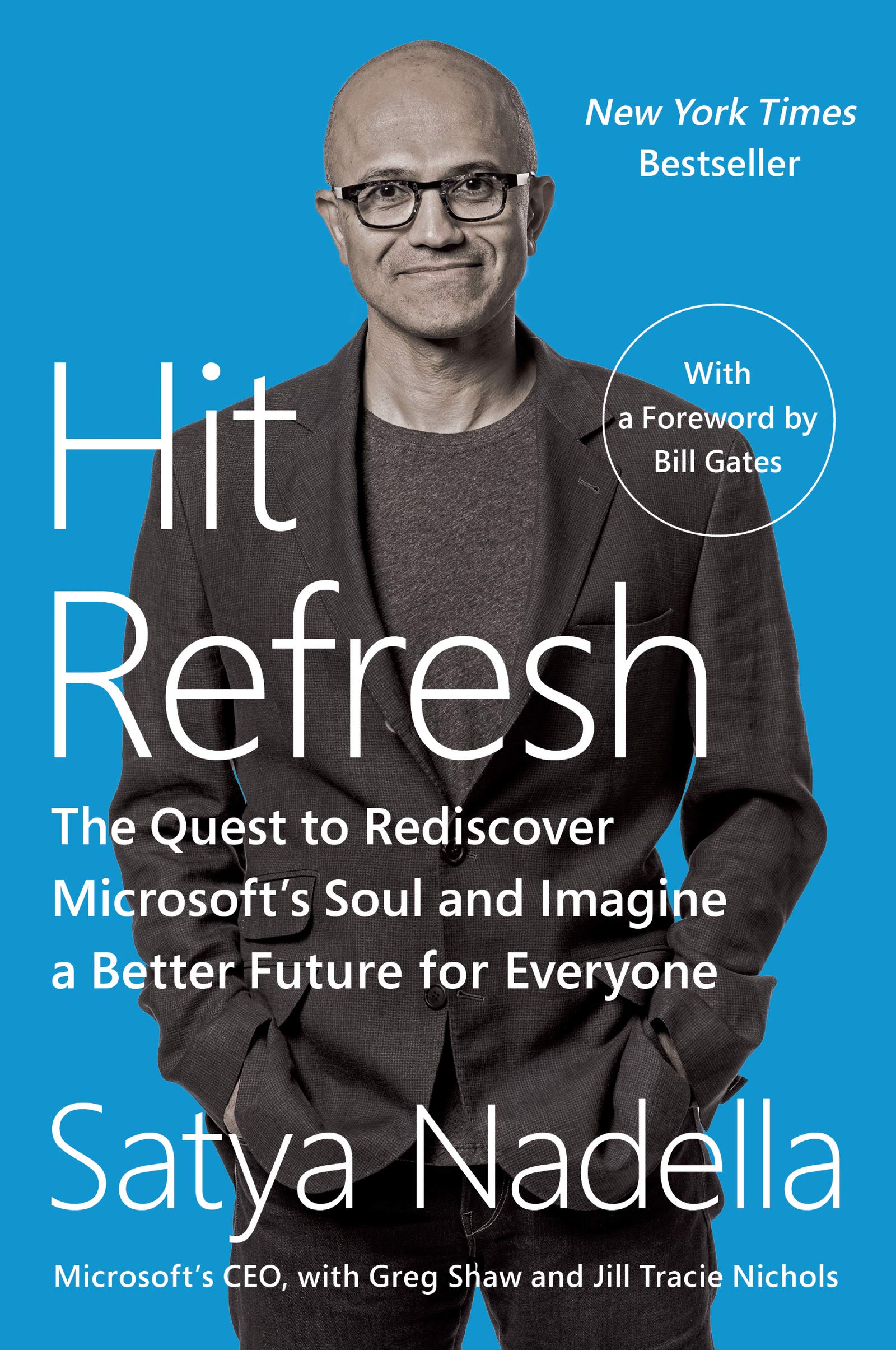
Hit Refresh
Satya Nadella
This book provides a powerful example of how growth mindset principles can transform a business, reshape culture, and unlock innovation.
The latest research suggests that a growth mindset is most powerful when supported by leadership and a culture that nurtures a growth mindset. People perform best when they believe development is possible and when their environment encourages development. Leaders therefore have a responsibility to model curiosity, invite feedback, reward learning, and demonstrate humility.
The Japanese call it Kaizen. Carol Dweck calls it a growth mindset. Satya Nadella describes it as becoming a ‘learn-it-all’ rather than a ‘know-it-all’ culture.
Whatever label you choose, the principle remains the same.
Keep learning.
Keep adapting.
Keep improving.
That is how people grow. That is how teams grow. And that is how businesses grow.
There are plenty more insights, exercises, and resources in the downloadable tools that accompany this edition of the Business Breakthrough report.
YOUR SUPPORT TOOLS ARE HERE:
Follow the link below for a set of practical tools to help you understand and build a stronger growth mindset.
Find the support tools to help you


© Remarkable Practice Ltd 2020 - All rights reserved