Expertise Builds Value Tools and Resources -Business

...solve thorny business challenges in the time it takes to drink a cup of tea
What if your ideal customers already wanted to buy from you - even before YOU knew THEIR name?
All of the information below is taken from or based on The Win Without Pitching Manifesto, by Blair Enns

@Freepik
Most business owners already know, deep down, that being a generalist is holding them back. It shows up in the awkward pitches, the constant price comparisons, and the customers who don’t really value what you do.
In The Win Without Pitching Manifesto, Blair Enns puts a name to that problem and offers a way out. Simple in theory, tough in practice.
The way out is expert positioning: choosing to be the obvious answer to a very specific problem for a very specific kind of customer. It’s not something you ‘grow into’. It’s a decision you make and then back up with consistent action.
These tools can help you do exactly that. They turn the idea into habits, frameworks, and daily moves you can apply. Go through it step by step and use the exercises. The people who get results treat this as an ongoing practice, not as a one-off project.
But before any of that, there’s one question to ask yourself. It’s the question at the core of Enns’ thinking, and it’s what separates the businesses that make this shift from the ones that stay stuck
STOP thinking that being a generalist is the safest and easiest option
START positioning yourself as an expert
The one ‘BREAKTHROUGH QUESTION’ you must ask to help yourself…
“Positioning is not a discovery. You don't wait for a niche to emerge organically over the years. You choose one. Deliberately. And then you go and build it." - Blair Enns, The Win Without Pitching Manifesto
This question matters because expert positioning is rarely a knowledge problem. Most business owners already know enough to specialise. They already have a cluster of customers they most enjoy serving. They already have a specialism they feel quietly proud of. What stops them is fear – the fear of turning others away, of missing out, of claiming something they're not yet certain they've fully earned.
The answer to the above question – the specific, honest, slightly-nervous-making answer – is usually the start of your positioning statement.
The sentence that makes you slightly nervous to commit to is usually the right one. Conviction is a competitive advantage. Ambiguity is invisible.
How to use this question:
Step 1 – Find 20 minutes to be quiet. Write your answer without editing. Don't show anyone yet.
Step 2 – Turn it into a full sentence: 'We are the only business that [specific thing] for [specific customer].'
Step 3 – Write five versions. Make each one more specific than the last.
Step 4 – The version that makes you slightly uncomfortable is usually the most powerful. That is your starting point.
The expert positioning framework – from generalist to sought-after expert
“Expertise is the only valid basis for differentiating ourselves… Not personality. Not process. Not price.” - – Blair Enns, The Win Without Pitching Manifesto
Blair Enns built his entire Manifesto around a single, powerful idea: the expert does not audition. The expert is the prize, not the contestant.
Getting from where most businesses are today – generalists competing on price – to where they want to be – sought-after specialists – follows a clear progression.
The framework below maps that journey in six stages. Each stage builds directly on the one before. Most businesses stall between Stages 2 and 3, precisely because the leap from choosing to claiming requires public commitment.
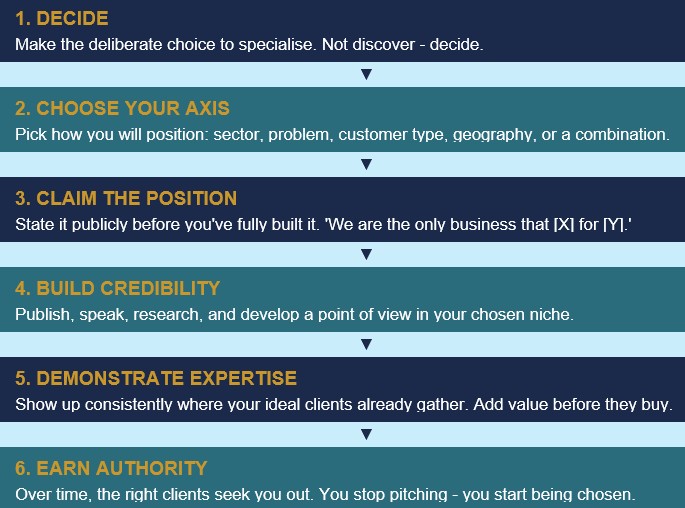
Taken from Blair Enns’ book, The Win Without Pitching Manifesto
Where are you on the journey?
Most business owners reading this are somewhere between Stages 1 and 3.
They have a sense of where they want to specialise but they haven't made the public commitment, or they've made it quietly but haven't yet built the credibility that makes it visible to the outside world.
If it sounds like you… | You are probably at… |
|---|---|
You take on almost any customer who can pay | Stage 1: Generalist – time to decide |
You prefer certain customers, but serve anyone | Stage 1–2: Transition – make the choice |
You've chosen your niche but haven't announced it | Stage 2–3: Bridge – claim it publicly now |
You've announced it, but have limited niche content | Stage 3–4: Building – publish and speak |
You're known in your niche but not yet sought out | Stage 4–5: Growing – deepen and demonstrate |
Ideal customers seek you out by reputation | Stage 5–6: Arrived – protect and compound it |
You do not need to have earned the right to call yourself a specialist before you claim the position.
You choose the position first. Then you build the expertise and reputation to back it up.
Choose your positioning axis – the 5 ways to specialise
“We will specialise. Not we will discover our specialism in time. A decision. Made today.” - Blair Enns, The Win Without Pitching Manifesto
Blair Enns identifies five distinct axes on which a business can position itself. Most businesses try to be everything to everyone. The expert picks one or combines two or three and builds on it.
The table below maps each axis, what it means, and how it looks in practice.
Positioning axis | What it means | Example |
|---|---|---|
By Sector / Vertical | You serve one industry. You know the language, the pressures, the cycles. Customers feel immediately understood. | Accountant who only works with healthcare businesses |
By Problem / Transformation | You solve one specific, recurring problem brilliantly. Customers search for solutions, not suppliers. | Consultant who turns enquiries into loyal repeat customers |
By Customer Type / Stage | You serve one type of buyer at a specific life stage or business stage. | Advisor for family businesses navigating succession |
By Geography + Specialism | Geography filters your market, combined with a specialism to create authority. | The go-to HR firm for hospitality businesses in the North West |
By Combination (Strongest) | Sector + Problem + Stage. Very few can claim this. Almost impossible to compete with. | Growth specialist for food and drink brands in their first five years |
How to choose your axis: the three questions
1. Where are your best existing customers already clustered?
Look at your customer list. Group them by sector, size, type, or problem. Where do you already have three, five, or eight in the same space? That cluster is the beginning of your natural position.
2. Where do you already have real, hard-won insight, even if you haven't named it?
The business that has served fifteen customers in the same sector for over ten years knows more than they realise. Seasonal pressures. Common pitfalls. The language of that world. You already have expertise. The question is whether you're willing to claim it.
3. Where could you most credibly be ‘the only’?
Not the best. The only. 'The only business that handles commercial property dilapidation disputes for independent retail landlords.' When a customer reads that, they think, "This is the person I need”.
Write five versions of this sentence. Make each one more specific:
1. We are the only business that ____________________________ for _______________________________.
2. We are the only business that ____________________________ for _______________________________.
3. We are the only business that ____________________________ for _______________________________.
4. We are the only business that ____________________________ for _______________________________.
Think about the last one:
5. We are the only business that ____________________________ for _______________________________ [most specific — the one that makes you slightly nervous].
Four ways to visibly build your expertise…
“Positioning is a decision. Not a discovery.” - Blair Enns, The Win Without Pitching Manifesto
Claiming your position is the start. Building the visible expertise to back it up is what converts a claim into authority.
Enns identifies four specific, practical ways to do this.
You don't need to do all four at once.
The recommendation is to start with one, execute it consistently, and add the next when the first becomes a habit.
Publishing:
Write about the specific challenges your target customers face. Not just generic tips, but specific, opinionated content about the pressures your ideal customers are navigating right now.
- Write one 500-800-word article per week on a sector-specific topic.
- Publish on LinkedIn, on your website, and in the sector's key newsletter or journal.
- Take a clear point of view. Agreeing with everything is invisible.
- One article that makes a business owner think 'they really get us' is worth a thousand promotional posts.
Speaking:
Find the events where your target customers gather. Show up and share a perspective, not a sales pitch. The expert speaking at the industry breakfast isn't selling; they're demonstrating.
- Identify the three or four sector events your ideal customers attend each year.
- Start by attending. Volunteer to introduce speakers. Then pitch for a 15-minute slot.
- Your talk should teach something genuinely useful, not be a thinly veiled pitch.
- One speaking opportunity generates referrals for months.
Research:
Run a survey, compile benchmarks.
Produce a 'state of the sector' report. Data is authority.
The business that owns the data becomes the business others reference and eventually call.
- Survey 30–50 businesses in your niche on a pressing challenge they share.
- Write a short report (4–8 pages) with the findings and your interpretation.
- Distribute via email, LinkedIn, and sector associations.
- Repeat annually to build a body of longitudinal data.
A point of view:
What do you believe that most competitors in your market don't?
That belief, stated clearly and argued well, is rarer and more valuable than any credential.
- Write your one-page manifesto for your chosen sector.
- What is broken in how businesses in your niche are served? What do you do differently, and why?
- Share it on your website under a heading like 'Our Belief' or 'What We Stand For'.
- This is your intellectual property; it attracts customers who share your worldview.
Enns' rule: Pick one of the four. Write 500 words on the sector-specific topic you know best. Publish it. That is the first brick. Habits compound. One brick a week becomes a wall within 12 months.
Your weekly habits and 90-day action plan – putting expert positioning into practice…
"The specialist's knowledge compounds. The more customers you serve in a specific sector, the more patterns you see, the better your advice becomes, the more trustworthy and valuable you become. Each customer makes the next one easier to win." - Blair Enns, The Win Without Pitching Manifesto
Expert positioning is not a project with a start date and an end date. It is a practice and a set of habits that, done consistently, compound into authority, reputation, and inbound demand. The businesses that successfully make the shift are the ones that build positioning activity into their week, not their wishlist.
Enns suggests that just 30 minutes a week, invested consistently and without fail, is enough to achieve a measurable shift inside 12 months. The table below gives you a structured rhythm to follow.
Positioning axis | What it means | Example |
|---|---|---|
Publish one piece of niche content | Weekly | Blog post, LinkedIn article, newsletter |
Engage in one sector community | Weekly | Comment, forum, association group |
Reach out to one potential referrer | Fortnightly | Introduce yourself as the specialist |
Attend one sector event or webinar | Monthly | Listen, network, don't pitch |
Review and update your positioning sentence | Quarterly | Sharpen it as your expertise deepens |
Produce a sector insight or data piece | Quarterly | Survey, benchmark, trend report |
Speak at one sector event | Every 6 months | Association, conference, online panel |
Then use the planner below to commit to your first 90 days of positioning activity. Tick off each action as you complete it. Share this with your team so they can hold you to it.
Positioning axis | What it means | Example |
|---|---|---|
Write your expert intention sentence | Week 1 | Done ✓ or not Done X |
Audit your current customers and identify clusters | Week 1-2 | Done ✓ or not Done X |
Choose your positioning axis | Week 2 | Done ✓ or not Done X |
Identify the sector events where your ideal customer gathers | Week 2-3 | Done ✓ or not Done X |
Write and publish your first niche content piece | Week 3-4 | Done ✓ or not Done X |
Join one sector association or community | Week 4 | Done ✓ or not Done X |
Set up a LinkedIn content rhythm (weekly posts) | Month 2 | Done ✓ or not Done X |
Brief your team on the new positioning | Month 2 | Done ✓ or not Done X |
Attend your first sector event | Month 3 | Done ✓ or not Done X |
Commission or run a piece of sector research | Month 4-6 | Done ✓ or not Done X |
Seek a speaking slot at a sector event | Month 6-12 | Done ✓ or not Done X |
The Vituous Cycle:
Serve your niche.
Learn more.
Become better at serving it.
Attract more customers.
Charge more.
Each customer makes the next one easier to win.
Each year, the compound interest of deep expertise widens your advantage over every generalist in your market.
Remember: The expert is the prize, not the contestant.
When you are genuinely positioned as the expert, customers call you. They arrive having already decided they want to work with you. The conversation does not begin with 'tell me about your services', but 'how do we start?'
The book and other resources
The Win Without Pitching Manifesto, by Blair Enns, is a sharp, contrarian take on how creative and service businesses win work. Instead of chasing clients through pitches and proposals, Enns argues for a complete shift: specialise, position yourself as an expert, and lead the relationship on your terms.
The book is structured as a set of bold “proclamations” that challenge deeply ingrained habits, such as giving away thinking for free or competing on price, and replaces them with a more disciplined, expert-led approach. It’s short, direct, and often uncomfortable, but that’s the point: it pushes you to rethink how you sell, whom you serve, and how much control you actually have in your business.
What people said about the book:
“Enn’s ideas have been widely adopted in agency and consulting leadership thinking. His “death to the pitch” philosophy positions him as a respected authority in creative business strategy rather than a traditional marketer.” – Forbes
“This book should be read by every creative who sells their work and every creative agency leader. Blair is shaking the agency world up and bringing us into the 21st century. If you want to be paid more and have less competition, then take heed of the principles explained in this book. Fantastic book and easy to read.” – HBR
If you want to hear more about what Blair Enns has to say on expert positioning, then please watch the ‘Consulting Success’ podcast.
In this conversation, he shares:
- His counterintuitive decision to stop chasing scale and instead re-engineer his business for simplicity and fulfilment.
- His entire sales system.
- The Four Conversations framework, designed to help experts stop acting like salespeople and start showing up as the discerning, in-demand advisors they are.
- The single biggest mistake experts make in sales.
- Why moving ‘down market’ is a trap.
- How to close deals without ever pitching.
YOUR SUPPORT TOOLS ARE HERE:
Click the button below and you'll be able to download a PDF version of this page.
