Build a Growth Mindset Tools and Resources

...solve thorny business challenges in the time it takes to drink a cup of tea
Could your team’s mindset be the biggest obstacle to your business growth?
All of the information below is taken from or based on Mindset, by Carol S. Dweck, and Hit Refresh, by Satya Nadella.

@Freepik
Your Business Breakthrough report makes the case that mindset, not talent, is the biggest lever available to any leader. Carol Dweck's research into fixed and growth mindsets, and Satya Nadella's account of turning Microsoft from a ‘know-it-all’ into a ‘learn-it-all’ culture, both point to the same conclusion: businesses that learn faster than their competitors win.
Knowing this is one thing; building it into daily behaviour is another. These tools and resources turn those ideas into practical tools you can start using this week. They include a checklist to run before any big challenge, proof (including a surprising one about learning to draw) that skill is built rather than born, and a simple routine for turning all of this into a lasting habit for you and your team.
But before any of that, there’s one breakthrough question to ask yourself. It’s the question at the core of both Dweck and Nadella’s books and the key to building a growth mindset in your business.
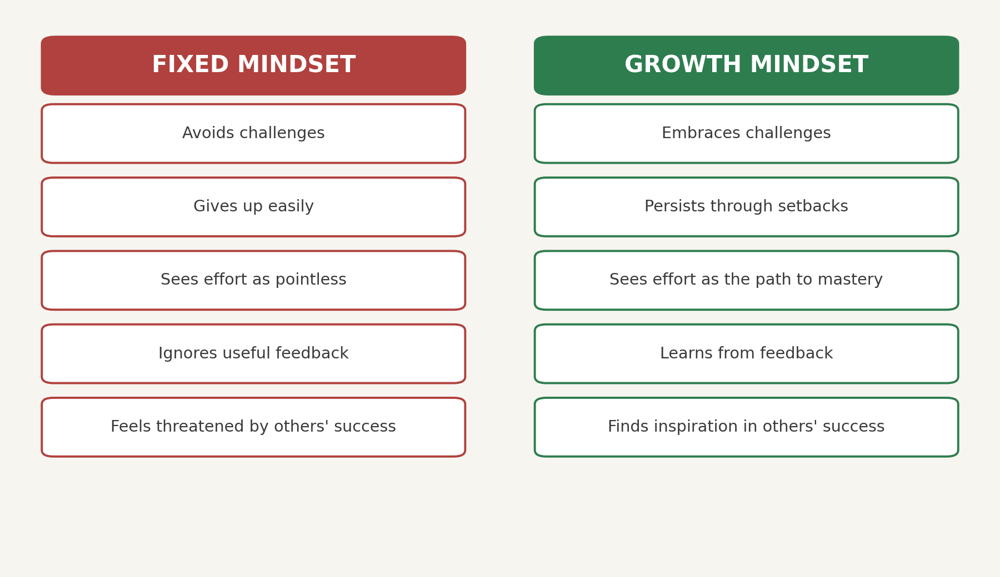
STOP defending old assumptions, avoiding feedback, and assuming that talent matters more than development.
START embracing challenge, encouraging learning, sharing lessons, and creating a culture where improvement is valued.
The one ‘BREAKTHROUGH QUESTION’ you must ask to help yourself…
“Anyone who has never made a mistake has never tried anything new." – Albert Einstein
Carol Dweck's research shows that mindset earns its keep at one specific moment: the instant you hit a struggle, a setback, or a piece of criticism. How you interpret that moment decides whether you stay engaged and keep improving or disengage and protect your ego. Satya Nadella makes the same point in Hit Refresh; he states that the tougher things get, the more deliberately you need to put your growth mindset in the driver seat.
So, where is the value in this breakthrough question?
This question prompts you to consider whether you’re ready to tackle the difficulty you face in a wholehearted, committed, and energetic way. The same question can also be used to challenge any of your colleagues about their mindset. This ‘challenge’ can then be used to set up a conversation about:
- Taking on the challenge wholeheartedly
- Learning from your setbacks and trying again
- Hearing the criticism and acting on it
Rather than taking a person’s mindset for granted, it pays to challenge their frame of mind using this question, connected with the business challenge of the moment.
Get mindset right first, then work out your responses to the difficulties you face.
Certainty is a positive thing if it’s certainty that we can all learn new and better ways of doing things, such as learning to drive.
However, certainty can be negative if it’s certainty that your intelligence, character, skill, and creativity are fixed and can’t be improved. This mindset freeze-frames your thinking, locks in old behaviour, and limits your business potential.
Using these tools can help you start conversations with your team (and yourself) to help stimulate success, growth, and a learning mindset.
Check out the rest of the tools here to help you build your growth mindset skills.
The Growth Mindset Checklist
“A problem is a chance for you to do your best.” – Duke Ellington
Use this checklist to give yourself confidence that you are genuinely applying a growth mindset, not just claiming one, the next time a business challenge lands on your desk.
Run through it before, during, and after the challenge.
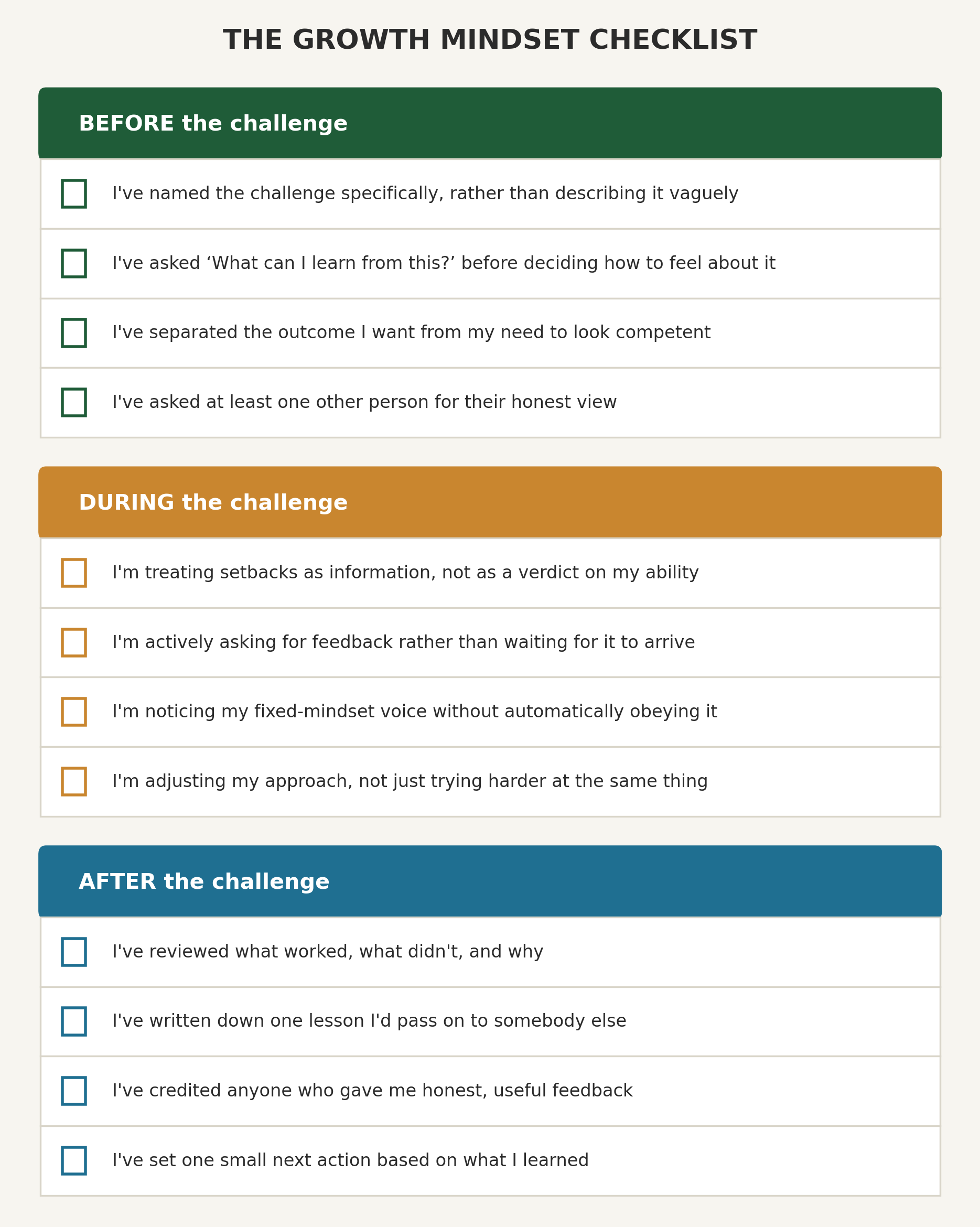
This checklist was developed for these tools, and is not a passage from either book; it applies Dweck's research on growth mindset behaviours in a practical before/during/after format.
Mindset 'moments of truth' make all the difference
"We are what we repeatedly do. Excellence, then, is not an act, but a habit."– commonly attributed to Aristotle
Why this comes down to habit
Human brains are wired to build habits. It's not a flaw; it's what makes us efficient. Without the ability to turn repeated actions into automatic ones, we'd spend so much mental energy on routine decisions that we'd get far less done each day.
The trouble is, forming habits is a double-edged sword. It's a huge asset when the habits we build support what we're trying to achieve. It becomes a liability when those same habits work against our ability to improve, adapt, or do things differently.
So where does mindset come into this?
At the moment, when something goes wrong – a setback, a piece of criticism, a difficult conversation – most of us don't consciously choose our response. We react out of habit. And that response usually isn't spoken aloud; it's the sentence we say to ourselves, silently, in our own heads.
If a fixed mindset has become your default, that internal sentence tends to follow a familiar script: "I knew I couldn't do it," "I've never been any good at this," "I shouldn't have bothered trying." The words vary, but the pattern doesn't.
But there is an opportunity here: because the fixed mindset response shows up only at moments of difficulty, those same moments can become your cue to interrupt it. Every challenge, setback, or piece of criticism is a chance to catch the old script before it plays out and allows you to consciously swap in a growth mindset response instead. Do that often enough, and you're not just having an isolated good moment. You're building a new default.
That's easier said than done, because few habits run deeper than the way we talk, both to others and to ourselves. For example, when someone asks how you're doing, what comes out automatically? "Fine, thanks." Perhaps it’s something more distinctive? Whatever it is, it's probably nearly identical every time. That's a habit running on autopilot, and our mindset responses work the same way.
The skill, then, isn't willpower in the moment, it’s spotting the instant a challenge arrives and using that as the trigger to run through the checklist above before your default response takes over.
Proof that a skill is built, not born
“Talent is never enough. With few exceptions, the best players are the hardest workers.” – Magic Johnson
According to Betty Edwards, whose five-day drawing courses have run for decades, almost anyone can learn to draw to a surprisingly high standard, regardless of any ‘natural talent’. Her students' before-and-after portfolios are well known in creativity circles: rough, childlike sketches on day one give way to confident, accurate portraits by day five.
Her method doesn't try to teach talent. It teaches five specific, learnable perceptual skills, such as seeing edges accurately, judging proportion and space correctly, and reading light and shadow. Master the five skills deliberately and, in a matter of days, the drawing improves dramatically.

Before and after drawings from Betty's students
Drawing a perceived object (so-called “realistic” drawing), Edwards proposes, is a visual perceptual skill made up of five component skills. These are the basic skills that students learn from Betty’s workshops (and her book):
1) Seeing and drawing edges (sometimes called “contour drawing”)
2) Seeing and drawing spaces (called “negative spaces”)
3) Seeing and drawing relationships (called “perspective and proportion”)
4) Seeing and drawing lights and shadows (called “shading”)
5) Seeing and drawing the whole (called the gestalt, the “thing itself,” the essential nature of the observed subject, which emerges spontaneously from the first four component skills)
Why does this matter for your business? Negotiation, coaching, public speaking, reading a balance sheet, and using new technology are no more ‘fixed talents’ than drawing is. Every one of them breaks down into specific, learnable sub-skills. If a complete beginner can learn to draw in five days, your team can learn the specific skills your business needs, provided you break them down and practise them just as deliberately.
Spanx: celebrating failed attempts
Sara Blakely, who built Spanx from a $5,000 investment into a billion-dollar company, has often credited a childhood dinner-table ritual for her resilience. Her father would regularly ask her and her brother what they had failed at that week and celebrate the attempt rather than the outcome. Growing up, failure came to mean ‘I tried something new’, instead of ‘I'm not good enough’. That reframing became a habit she carried straight into building her business.
Ford: making it safe to say ‘red’
When Alan Mulally became CEO of Ford in 2006, the company was heading toward billions of dollars in losses. He introduced a weekly review where every executive rated their area green, amber, or red, yet for months, everyone reported green, even as the business bled money.
Nobody felt safe admitting a problem. When one executive finally reported red and was praised, not punished, the culture shifted almost overnight and problems began surfacing early, while they could still be fixed. Ford returned to profitability and avoided the government bailout that its rivals needed.
Microsoft: a Friday ritual for learning
Satya Nadella's own growth mindset story started at home. In 2014, as he was about to take over as Microsoft's CEO, his wife handed him a copy of Carol Dweck's Mindset, sensing it might help him rethink the business.
He did more than adopt the language; he built a specific habit into his leadership team's calendar. Each Friday, one member of the team had a standing job: find a genuine story from somewhere inside Microsoft of someone living the culture they wanted to build and then bring it back to share. It cost nothing and took minutes, but it repeated every week, modelled from the top, exactly the kind of small, visible ritual you could build for your own team.
All three stories make the same point as the drawing example: growth mindset isn't a personality trait some people have, and others don't. It's a set of behaviours – trying, admitting, reviewing, adjusting – that can be deliberately built, modelled, and rewarded.
Catch it, Choose it, Change it – the Growth Mindset dialogue script
“I've always believed that if you put in the work, the results will come.” – Michael Jordan
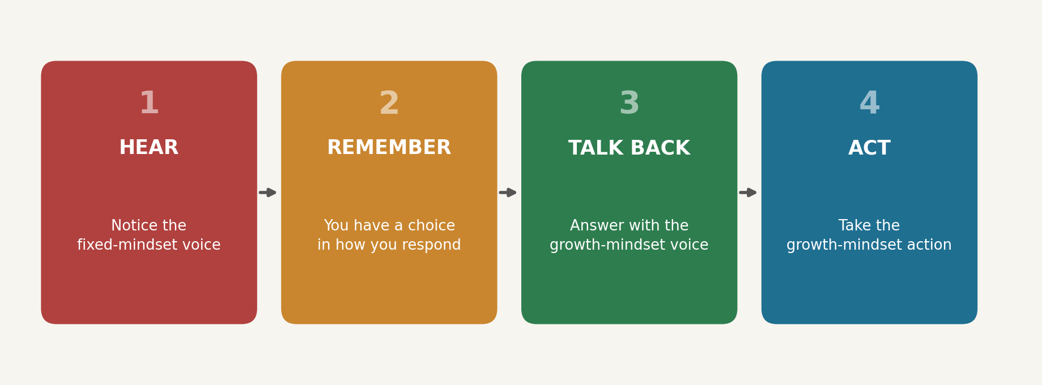
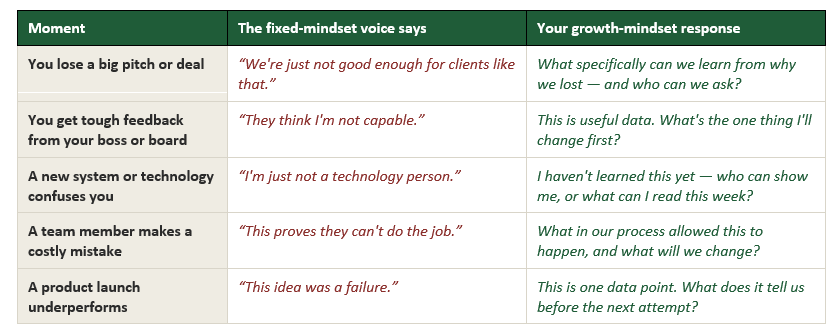
The Business Breakthrough report sets out 4 steps for tipping the odds toward a growth mindset: hear the fixed mindset voice, remember you have a choice, talk back with the growth mindset voice, then take the growth mindset action. Here's how to put that into practice at the exact moments it matters most in business.
The four-step framework below comes from the Business Breakthrough report. The script table below is a practical tool developed for these tools and resources, and is not a passage or exercise from either book.
How to establish this habit
1. Make this table larger, print it, and pin it where your team can see it: on a noticeboard, a shared channel, or the inside cover of a notebook.
2. Run it as a 10-minute discussion in your next team meeting. Ask people to add their own real examples to each row.
3. The next time you catch yourself using a fixed mindset line, say the growth mindset response out loud, even if you don't yet fully believe it. Believing follows practice, not the other way round.
Build the habit – a 30-day Growth Mindset Routine
None of the other tools will stick without a routine behind them. Growth mindset, like Toyota's Kaizen, is built from small, consistent improvements rather than one big breakthrough, and small improvements only compound when repeated.
This 30-day routine was developed for these tools and is not an exercise from either book. It applies the same small-steps logic as Kaizen and the growth mindset research to help the habit stick.
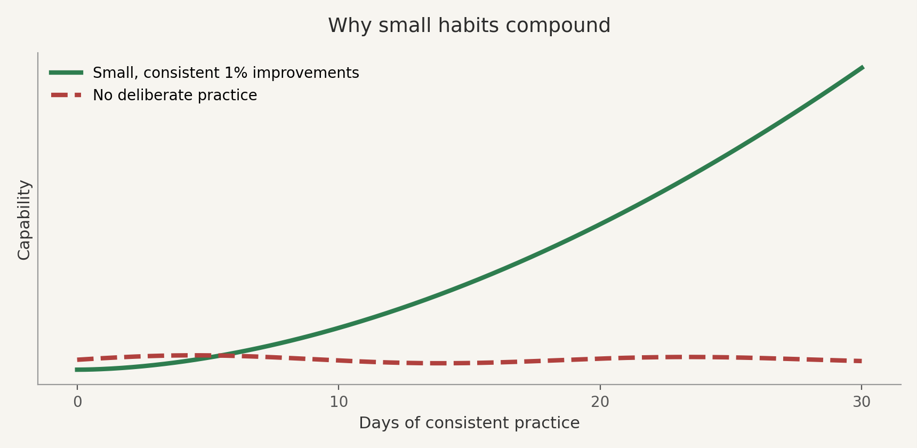
Two simple habits
1. Daily (2 minutes): at the end of each day, log one challenge you faced and one lesson you took from it – a ‘one line a day’ learning journal.
2. Weekly (15 minutes): add ‘What did we learn this week?’ as a standing item in your existing team meeting, built around three questions:
- What did we try?
- What worked?
- What will we do differently next week?
Your 30-day tracker
Tick a box each working day that you complete your one-line learning journal or raise something in the weekly review.

This week's challenge
Pick one live business problem. Run all five tools against it: ask the one question, work the checklist, remember that the skill involved is learnable, script your growth mindset response, and log the lesson in your tracker. Notice what changes.
The research behind it – mindset, engagement and performance
“Coming together is a beginning. Keeping together is progress. Working together is success.” – Henry Ford
This isn't just a nice idea. Growth mindset connects directly to one of the most heavily measured outcomes in business: employee engagement, which, in turn, connects directly to profit.
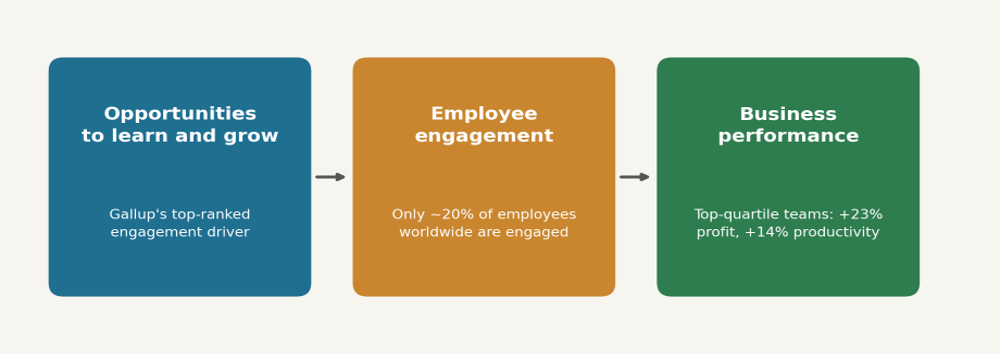
What the numbers say
- Gallup's Q12 engagement survey, used by organisations worldwide, places ‘opportunities to learn and grow’ at the very top of its hierarchy of engagement needs, above teamwork, recognition, and even having a best friend at work.
- Yet growth opportunities remain scarce: only around 20% of employees worldwide, and roughly a third in the US, say they are genuinely engaged at work (Gallup, 2025–26 data).
- The businesses that get this right see the difference. Gallup's analysis of more than 183,000 business units found that top-quartile teams are 23% more profitable and 14% more productive than bottom-quartile teams.
- Growth mindset research draws the same line more directly: In a 2024 survey of senior leaders, 58% credited a growth mindset culture with improving employee engagement, alongside 64% reporting higher productivity (TalentLMS, Growth Mindset in the Workplace).
- Here’s one finding worth building your habits around: Gallup finds that managers account for at least 70% of the difference in engagement between one team and another, which is exactly why the Microsoft story above and focus on habits in these tools put the leader's own visible behaviour front and centre.
Put together, the message is consistent: build real opportunities to learn into how your business runs and then model that visibly as a leader. Both engagement and the performance that follows it move with it.
Straight from the books
Two pieces of evidence sit right at the heart of mindset and are worth knowing in more detail.
The praise experiment
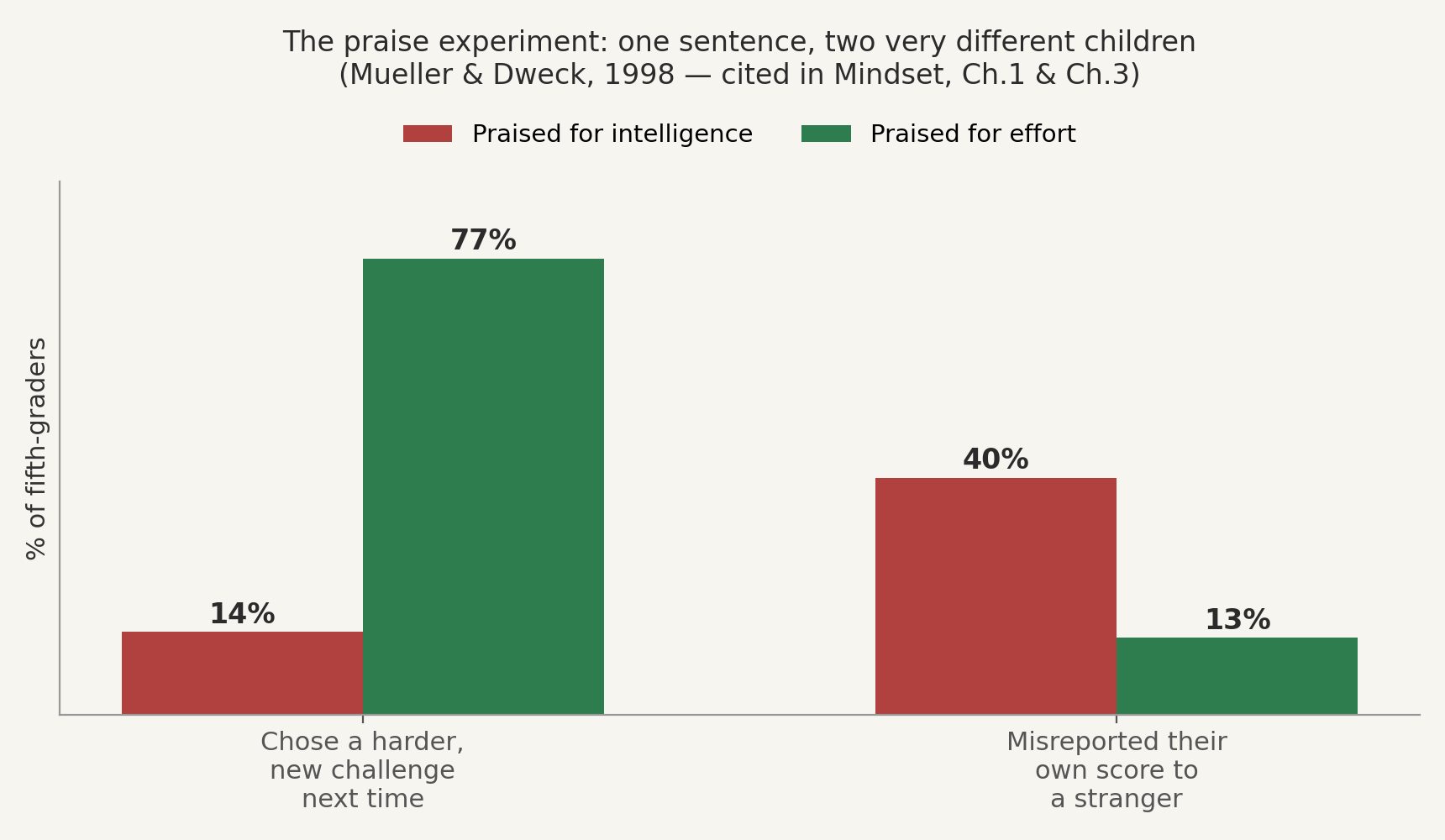
In a landmark 1998 study, which Dweck discusses at length in Mindset, researchers gave hundreds of ten-year-olds a simple test, then praised half of them for being smart and the other half for trying hard. That one sentence of praise was enough to change how the children behaved next: when told they could choose their next task, the effort-praised group overwhelmingly picked a harder challenge, while most intelligence-praised children played it safe.
After a deliberately difficult round designed to make everyone struggle, the intelligence-praised group's performance fell furthest, and when asked to report their own scores to a stranger, they were roughly three times more likely to lie about them.
Fixed mindset CEOs versus growth mindset CEOs
Mindset's business chapter draws the same line through the corner office. Dweck contrasts leaders such as Lee Iacocca at Chrysler, Al Dunlap at Scott Paper and Sunbeam, and Jeffrey Skilling at Enron, all talented, all convinced their own brilliance was the company's core asset, with growth-minded leaders such as Lou Gerstner at IBM, Jack Welch at GE, and Anne Mulcahy at Xerox, who built their turnarounds by asking hard questions and surrounding themselves with people willing to disagree with them.
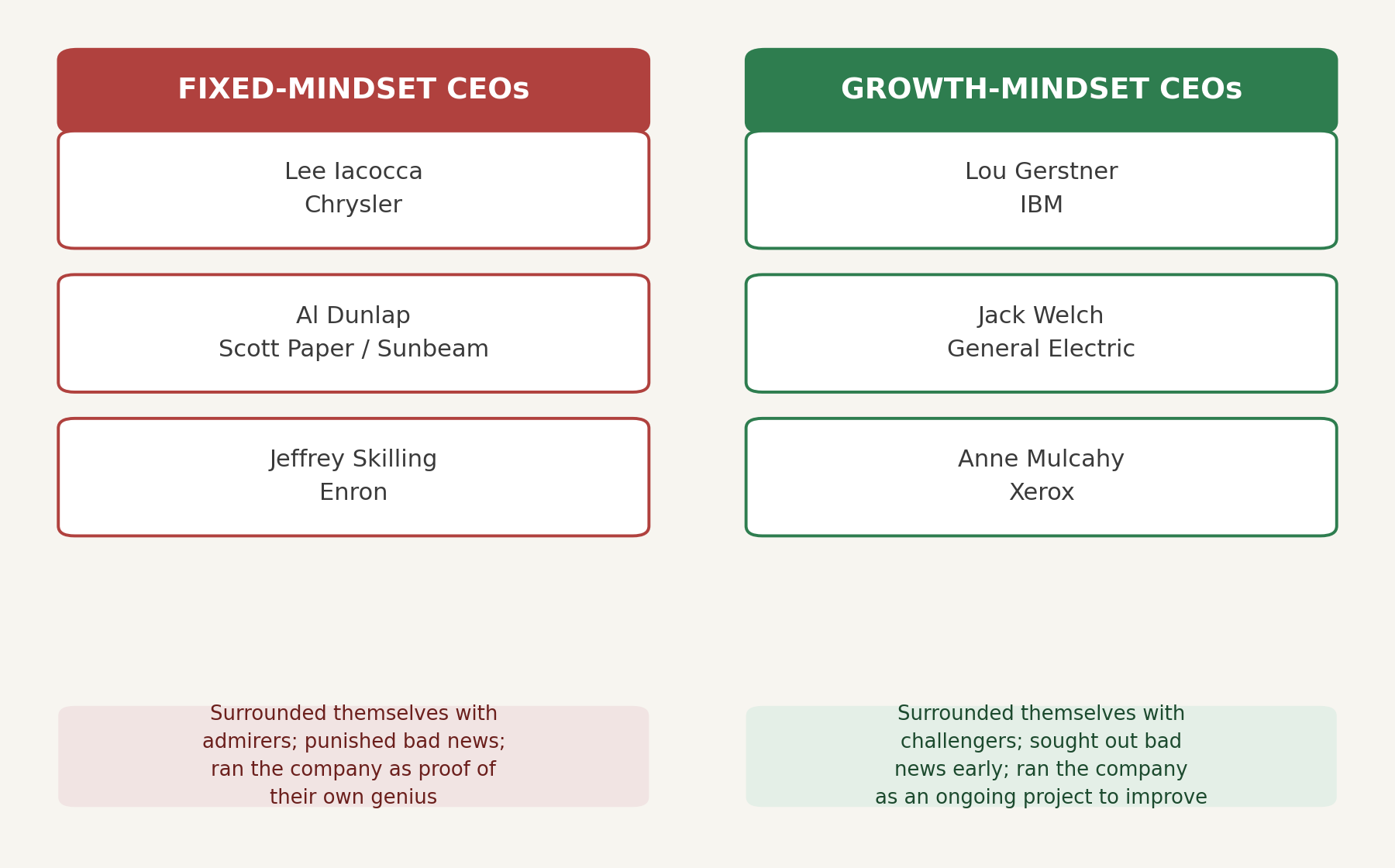
The pattern matches the business stories above: the leaders who stayed curious about their own weaknesses built companies that lasted; the ones who needed to be seen as infallible built companies that didn't.
Nadella's own leadership model
Separately from Hit Refresh itself, Nadella has described his personal leadership philosophy in interviews and internal Microsoft communications as three short phrases, developed with Microsoft's talent team in 2016 and still used across the company today. It isn't a passage from the book, but it comes from the same growth mindset era it describes.
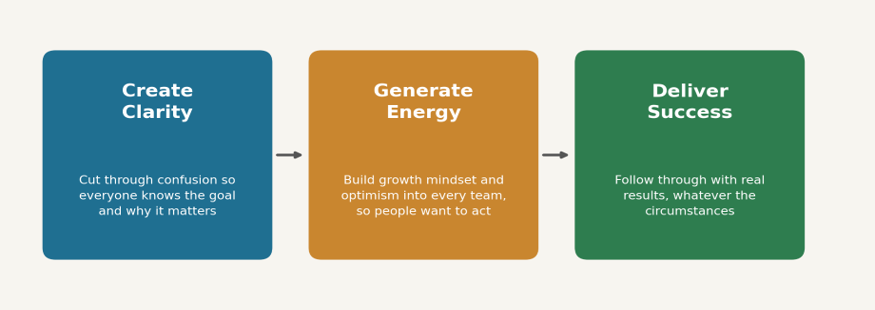
As a leader, you must create clarity so your team knows what they're working towards, and you must generate energy by visibly running on a growth mindset yourself. Then you must deliver on it, rather than letting effort substitute for real results.
The book and other resources

Mindset
Dr Carol S. Dweck
Carol Dweck’s Mindset: The New Psychology of Success explores a simple but powerful idea: the beliefs we hold about our abilities can have a significant impact on how we learn, perform, and respond to challenges. Dweck distinguishes between a fixed mindset, where people believe their intelligence and abilities are largely set, and a growth mindset, where people believe they can develop through effort, learning, practice, and persistence.
For businesses, the implications are significant. A growth mindset can help people to see challenges as opportunities to learn rather than as threats to avoid, to view mistakes as valuable feedback, to become more willing to seek help, to try new approaches, and to develop new skills. Creating this kind of mindset across a team can support greater engagement, resilience, and performance, particularly in a world where businesses and their people need to continually adapt and improve.
What people said about the book:
“An utterly compelling story of how the way we think shapes our success. Essential reading for anyone with aspirations.” – Matthew Syed
“Everyone should read this book.” – Chip Heath and Dan Heath
“One of the most influential books ever about motivation.” – Po Bronson

Hit Refresh
Satya Nadella
Satya Nadella’s Hit Refresh tells the story of Microsoft’s transformation and the role that mindset played in changing the company’s culture and performance. When Nadella became CEO, he championed the idea of moving from a culture of ‘know-it-alls’ to ‘learn-it-alls’, encouraging curiosity, continuous learning, and a willingness to embrace change. The book demonstrates how a growth mindset can be applied across an entire organisation, helping people become more collaborative, innovative, and open to new ideas. It is a powerful example of how changing the way people think can help transform not just individual performance, but the performance and future of an entire business.
What people said about the book:
“Satya has charted a course for making the most of the opportunities created by technology while also facing up to the hard questions. He offers his own fascinating personal story, more literary quotations than you might expect, and even a few lessons from his beloved game of cricket.” – Bill Gates
Watch this video and hear Michael Jordan describe how his growth mindset attitude shows up in the hard work and training essential to his success…
Kaizen – continuous improvement – is a way of life for top sportsmen and sportswomen. Learning from errors, such as missed game-winning shots, are expected if you’re to be a top-class athlete. It’s this Kaizen approach that supports their progress and their success.
How many coaches and athletes do you hear say it’s mostly the mind, rather than the skill and talent, that is responsible for their success?
Here’s Dr Carol S. Dweck describing her mindset insights in her own words to help you gain a deeper understanding of the Kaizen mindset:

YOUR SUPPORT TOOLS ARE HERE:
Click the button below and you'll be able to download a PDF version of this page.