Expertise Builds Value Tools and Resources -Accs

...solve thorny business challenges in the time it takes to drink a cup of tea
What if your ideal clients already wanted to buy from you - even before YOU knew THEIR name?
All of the information below is taken from or based on The Win Without Pitching Manifesto, by Blair Enns

@Freepik
Most accountancy firm owners already know, deep down, that being a generalist is holding them back. It shows up in the awkward pitches, the constant price comparisons, and the clients who don’t really value what you do.
In The Win Without Pitching Manifesto, Blair Enns puts a name to that problem and offers a way out. Simple in theory, tough in practice.
The way out is expert positioning: choosing to be the obvious answer to a very specific problem for a very specific kind of client. It’s not something you ‘grow into’. It’s a decision that you make and then back up with consistent action.
These tools can help you do exactly that. They turn the idea into habits, frameworks, and daily moves that you can apply. Go through it step by step and use the exercises. The people who get results treat this as an ongoing practice, not as a one-off project.
But before any of that, there’s one question to ask yourself. It’s the question at the core of Enns’ thinking, and it’s what separates the firms that make this shift from the ones that stay stuck
STOP thinking that being a generalist is the safest and easiest option
START positioning yourself as an expert
The one ‘BREAKTHROUGH QUESTION’ you must ask to help yourself…
“Positioning is not a discovery. You don't wait for a niche to emerge organically over the years. You choose one. Deliberately. And then you go and build it." - Blair Enns, The Win Without Pitching Manifesto
This question matters because expert positioning is rarely a knowledge problem. Most firm owners already know enough to specialise. They already have a cluster of clients they most enjoy serving. They already have a specialism they feel quietly proud of. What stops them is fear – the fear of turning others away, of missing out, of claiming something they're not yet certain they've fully earned.
The answer to the above question – the specific, honest, slightly-nervous-making answer – is usually the start of your positioning statement.
The sentence that makes you slightly nervous to commit to is usually the right one. Conviction is a competitive advantage. Ambiguity is invisible.
How to use this question:
Step 1 – Find 20 minutes to be quiet. Write your answer without editing. Don't show anyone yet.
Step 2 – Turn it into a full sentence: 'We are the only firm that [specific thing] for [specific client].'
Step 3 – Write five versions. Make each one more specific than the last.
Step 4 – The version that makes you slightly uncomfortable is usually the most powerful. That is your starting point.
The expert positioning framework – how accounting firm leaders can create the perception of deep expertise in the minds of business owner clients
“Expertise is the only valid basis for differentiating ourselves… Not personality. Not process. Not price.” - – Blair Enns, The Win Without Pitching Manifesto
Blair Enns’ core argument, developed through The Win Without Pitching Manifesto and Pricing Creativity, is that the expert practitioner must fundamentally reverse the typical buyer-seller dynamic. Instead of pursuing clients and pitching for work, the expert attracts clients through demonstrated depth and then leads the engagement from a position of authority – much like a specialist consultant rather than a supplier.
What follows is his thinking mapped onto a practical six-step sequence, translated specifically for accounting firm leaders working with business owner clients.
Step 1: Narrow and name your expertise
Enns is emphatic that the deepest level of perceived expertise is specificity. A generalist is pleasant to work with; a specialist is sought out. The first step is for the firm, or the individual leader within it, to stake a clear claim.
Not: “We work with owner-managed businesses.”
But: “We work with manufacturing businesses turning over £2-20M who are preparing for a management buyout or external sale.”
For Accounting Leaders
This means resisting the gravitational pull of the full-service offering in initial positioning conversations. When a business owner hears something precise that maps onto their situation, their internal response is “they know my world”, and that is the beginning of trust.
Step 2: Lead with a point of view, not a capability statement
Enns argues that experts don’t open with “here’s what we do”. They open with a considered perspective on the client’s world – what is changing, what the risks are, and what most people in their position get wrong.
He calls this having a point of view (POV), and it is the engine of thought leadership.
For Accounting Leaders
Before discussing services, a partner meeting with a business owner should include observations such as:
“Most founders at your stage are underestimating the tax efficiency gap between how they’re currently structured and what a buyer will expect to see in three years.”
That’s a POV. It immediately signals that you understand their context at a strategic level – not just their compliance needs.
Step 3: Diagnose before you prescribe
This is perhaps Enns’ most powerful idea. He uses the doctor analogy deliberately: a good physician asks searching questions before recommending treatment. Any doctor who prescribed without diagnosing would be struck off. Yet most professional service firms arrive at a first meeting already mentally constructing their proposal.
The diagnostic conversation is structured around questions that reveal depth, not questions that gather information for a quote. The distinction matters enormously to the business owner sitting across the table.
For Accounting Leaders
Questions such as: “What does your current finance function tell you about your cash conversion cycle, and how confident are you in that picture?”
…do two things simultaneously: they bring to the surface genuinely useful diagnostic information, and they demonstrate that you think at a level most advisers don’t reach. Enns calls this diagnosing in public: the quality of your questions is itself the proof of expertise.
Step 4: The three conversations in sequence
Enns identifies three conversations that must happen in the right order in any new client relationship. Many firms conflate them or skip one entirely, which undermines the expert dynamic.
1. The fit conversation
This establishes whether the client’s situation sits inside your area of genuine expertise. Crucially, Enns insists that the expert must be willing to disqualify, to say, credibly, “I’m not sure we’re the right firm for this.” That willingness is itself a signal of confidence and selectivity that most advisers never project.
2. The money conversation
This happens before the work is scoped in detail. Enns argues strongly that talking about budget and value expectations early is a mark of professionalism, not awkwardness. It prevents the situation where a beautifully crafted proposal lands with a client who has a fundamentally different sense of what the engagement is worth.
3. The process conversation
This is where the expert explains how they work – on their terms, not the client’s. The expert leads the engagement. This subtly but powerfully reframes your firm’s relationship to the client from that of a supplier to that of an advisor.
For Accounting Leaders
Business owners are accustomed to their accountant following their lead. When a firm leader instead says, “Before we talk about what you need, let me explain how we approach this kind of work and why we do it that way,” the framing shifts. The business owner begins to orient themselves around the firm’s process rather than driving it themselves.
Step 5: Resist the pitch and replace it with a recommendation
Enns wrote an entire manifesto on this single point. Pitching, preparing speculative work, and competing on ideas before being appointed is an act of subordination. The expert doesn’t audition; they are selected. The pitch is replaced by a recommendation: here is what I have observed, here is my diagnosis, here is what I would recommend, and here is why.
For Accounting Leaders
The recommendation format – situation, diagnosis, proposed approach, and rationale – reads completely differently from a standard engagement letter or capability brochure. It signals that the firm has already done the thinking, and the business owner is invited to engage with a considered professional view, not with a menu of services with fees attached.
Step 6: Price the value, not the hours
Once the expert dynamic is established and the client is oriented toward you as the specialist, the conversation about price should be anchored to the value of the outcome, not to the cost of the inputs. Enns describes this as winning on value before winning on price: the business owner should understand what the advice is worth to them before a number is mentioned.
For Accounting Leaders
If a business owner understands that your restructuring advice could save them £150k in tax on a sale in three years, the context for a £15k advisory fee is completely different than if the fee arrives without that framing. This requires the firm leader to be willing to surface and discuss value explicitly, which is uncomfortable for many accountants trained in ‘cost plus fee’ structures.
The Underlying Architecture
What ties all six steps together is a single principle which Enns returns to repeatedly: the expert is not for everyone – and says so.
Selectivity, specificity, and the willingness to lead rather than follow are what create the perception of deep expertise in a client’s mind. For accounting firm leaders, whose default professional posture is often one of careful service and deference, Enns is essentially asking for a significant identity shift, closer, in fact, to the shift from technician to leader that underpins much of the best leadership development work in the profession.
The six-step sequence is a practical roadmap for making that shift visible and credible in every client conversation.
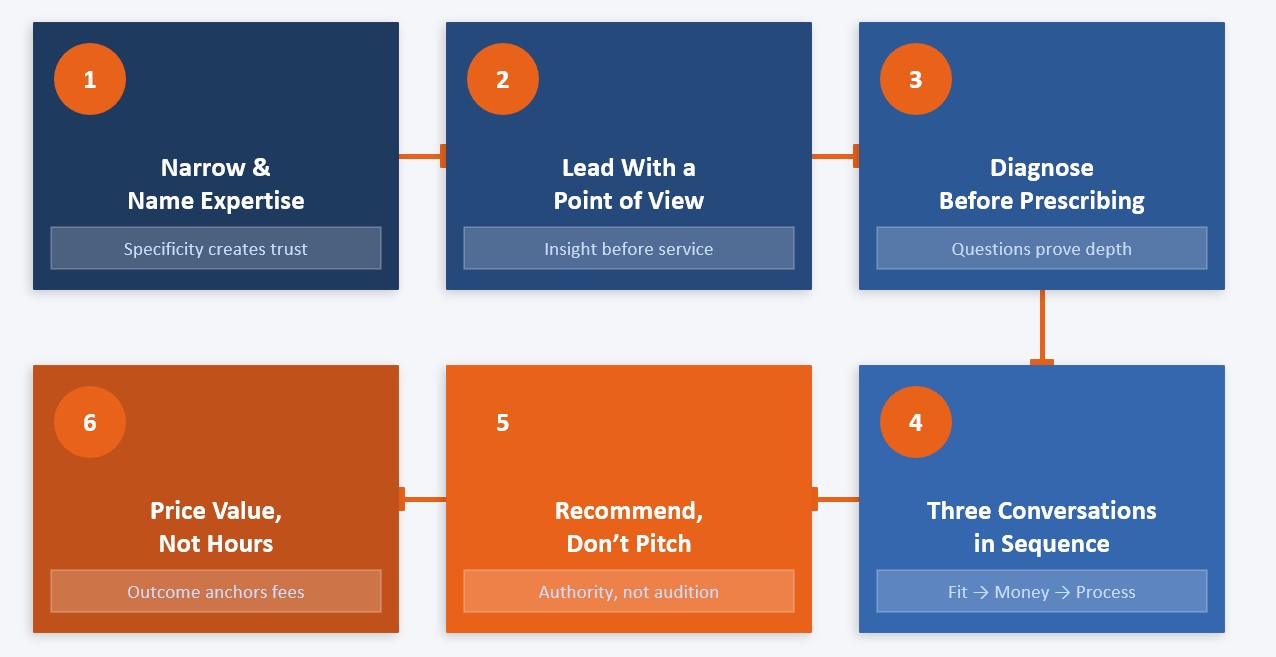
Taken from Blair Enns’ book, The Win Without Pitching Manifesto
Choose your positioning axis – the 5 ways to specialise
“We will specialise. Not we will discover our specialism in time. A decision. Made today.” - Blair Enns, The Win Without Pitching Manifesto
Blair Enns identifies five distinct axes on which a business can position itself. Most firms try to be everything to everyone. The expert picks one or combines two or three and builds on it.
The table below maps each axis, what it means, and how it looks in practice.
Positioning axis | What it means | Example |
|---|---|---|
By Sector / Vertical | You serve one industry. You know the language, the pressures, the cycles. Customers feel immediately understood. | Accountant who only works with healthcare businesses |
By Problem / Transformation | You solve one specific, recurring problem brilliantly. Customers search for solutions, not suppliers. | Consultant who turns enquiries into loyal repeat clients |
By Customer Type / Stage | You serve one type of buyer at a specific life stage or business stage. | Advisor for family businesses navigating succession |
By Geography + Specialism | Geography filters your market, combined with a specialism to create authority. | The go-to firm for hospitality businesses in the North West< |