Win with Quarterly OKRs Tools and Resources

...solve thorny business challenges in the time it takes to drink a cup of tea
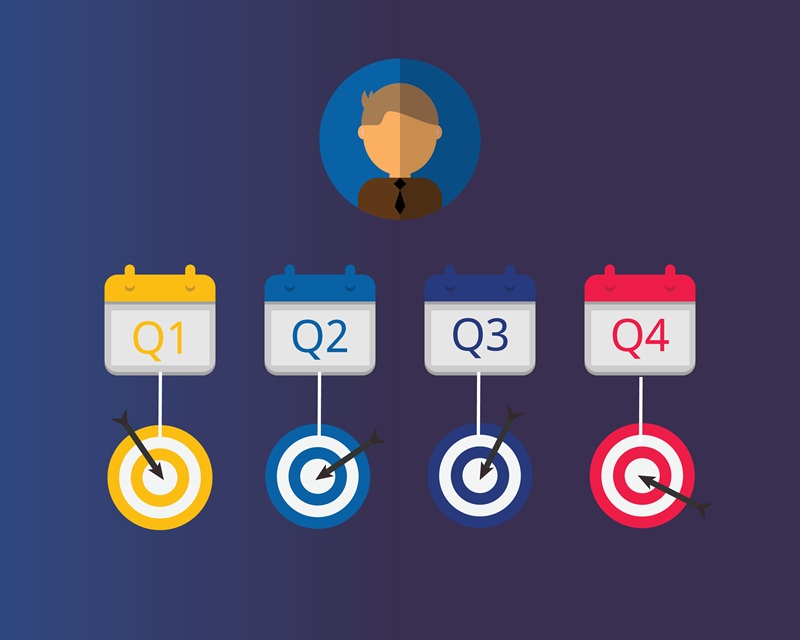
For your business to survive and thrive, how often should you set your goals?
@Freepik
You already know that if you spread your time, effort, energy, and team across too many projects, you’ll complete very little. Frustration will dominate your feelings. Your results will be poor, your team disheartened.
Instead, work out what to focus on, and what NOT to focus on, for this quarter. Google, Intel, a pizza company, a sole-owner designer, and many more businesses, have seen the power of having a clear priority each quarter, focusing on it, and tracking the results.
So, think about your business and ask yourself this two-part question:
To help you answer this question, here are a few insights, tools, and exercises so that you can ‘nail’ your priority for the next 13 weeks in your business – and behave a little more like Google.
STOP thinking you can do multiple business projects at the same time.
START making hard choices and exclude all but one priority for the next 13 weeks.
The one ‘BREAKTHROUGH QUESTION’ you must ask to help yourself…
“When you measure what matters, you achieve what matters.”– John Doerr, Measure What Matters
Your answer to this question tells you whether you and your team are clear on the single business priority you have for the next 13 weeks.
What is the value in this question?
The value lies in knowing you have worked out the single focus for your business this quarter.
It also tells you whether your priority has been clearly communicated to everyone in your business, as well as whether you are measuring the right things to achieve this goal and then adjusting when required.
The Business Breakthrough that accompanies these tools and the exercises and insights outlined below will help you work out your business priority (and then share it with everyone).
NB. This quarterly focus means that, at the end of 13 weeks, you have a decision to make, one that depends on how successful you’ve been in achieving your objective:
- run the project for a further 13 weeks to get your objective ‘over the line’ OR
- move on to focus on the next significant objective with key results for the following 13 weeks
OKRs defined – be clear on where you’re going and how you measure progress

“Ideas are easy. Execution is everything.” – John Doerr, Measure What Matters
Objectives and Key Results, or OKRs, have emerged as one of the most powerful tools for driving focus, alignment, and measurable outcomes in business.
In his book, Measure What Matters, John Doerr illustrates that OKRs are not simply a goal-setting framework, but a management system that turns strategy into action. By clearly defining ambitious objectives and pairing them with specific, quantifiable key results, businesses can concentrate their efforts on what truly matters, avoiding the common trap of diffused priorities or ‘busywork’ that contributes little to business impact.
OKRs also create a culture of transparency and alignment, allowing every team member to see how their work contributes to larger company goals, which enhances collaboration across departments.
Perhaps most importantly, Doerr emphasises the power of ambitious goals – objectives that push teams beyond incremental improvements and that encourage creativity, innovation, and learning, even if the goals are not fully achieved.
Through examples from successful businesses such as Google, Intel, YouTube, and even mission-driven businesses like the Gates Foundation, Doerr demonstrates that when OKRs are implemented thoughtfully, they cultivate a culture of accountability, agility, and relentless execution.
Businesses that adopt OKRs effectively can rigorously track progress, respond quickly to setbacks, and make data-informed decisions, creating a cycle of continuous improvement.
In their simplest form, OKRs provide both a compass and a measuring stick: they help businesses stay focused on strategic priorities while also providing a clear, objective way to evaluate success, motivate teams, and drive extraordinary outcomes in an increasingly complex business environment.
Here is an explanation of the term OKR:
The OBJECTIVE is a qualitative statement about what you want to achieve.
A KEY RESULT is a quantitative definition of what success looks like. It’s how you plan to measure the key activities that drive you to achieve your objective.
Some examples:
OBJECTIVE: I want to eat more fruit and vegetables.
KEY RESULT: Write down the consumption of fruit and vegetables each day in your food diary – noting the change.
OBJECTIVE: I want to get fit.
KEY RESULTS: Lose 5 lbs. Exercise 4 times a week for 20 minutes or more – no dairy for 13 weeks.
OBJECTIVE: Win 5 new ‘A’ grade clients.
KEY RESULTS:
1. Hold referrals conversations with every existing client.
2. Adopt a 2-meeting strategy with all prospects.
3. Use 3-option pricing with every prospect – record the results.
OBJECTIVE: Improve on-time delivery.
KEY RESULTS:
1. Stock-check raw materials are available on receipt of every order.
2. Start two new delivery contractors in Scotland.
3. ‘Red flag’ all orders with less than 2 weeks to the delivery date.
Objectives are always qualitative and aspirational. They are something that you, your team, or your business aim to achieve, and they should not contain numbers!
Key Results are always quantitative. They will tell you if you have achieved your objective, so they should be measurable to avoid any doubt. Even a Yes/No key result is numeric as the outcome is binary. For example, ‘Pass an exam’ is a valid key result which can have numeric values – either Yes (1) or No (0).
How to implement OKRs in your business…
(from John Doerr's book, Measure What Matters)

@Freepik
Implementing OKRs in your business is about turning big ideas into real action.
OKRs aren’t just another goal-setting tool; they’re a practical way to help teams stay focused, aligned, and clear on what success looks like.
OKRs help businesses move from ambition to execution by setting clear objectives and then measuring progress with meaningful results. When done well, OKRs create transparency, build accountability, and encourage teams to aim higher than they normally would.
This section walks you through how to put OKRs into practice step by step so that every effort is connected to what truly drives growth and success.
1. Start with Mission and Vision
Define your business’s purpose, values, and vision, as well as its long-term aspirations. OKRs should cascade from this foundation.
2. Set Objectives that Inspire
These should be qualitative and ambitious. Make sure you have a time span with an end date.
Example: Delight customers with world-class service.
3. Define 3 to 5 Key Results per Objective
Key results should be quantitative, measurable, and verifiable.
Example: Increase NPS from 50 to 70 by Q4.
4. Cascade and Align
Business OKRs → Department OKRs → Team OKRs → Individual team member OKRs.
Ensure alignment without rigid top-down control.
5. Check in Regularly
Ensure that there are weekly or bi-weekly progress reviews.
Discuss blockers and adjust as needed.
6. Score and Reflect
Perhaps use a scoring system like this:
0.7 to 1.0 = Success
0.4 to 0.6 = Progress
<0.4 = Needs improvement
Celebrate wins and learn from misses.
7. Embed OKRs into Culture
Make them visible and transparent to everyone.
Encourage feedback and change if needed.
OKRs aren’t just a framework. They’re a way to bring clear understanding and focus to what really matters. By setting bold objectives and then backing them up with measurable results, businesses can turn strategy into everyday action and build a culture where accountability and innovation thrive.
The steps outlined here offer a practical roadmap for weaving OKRs into how your business works, so that every team member understands their role and why it matters.
When used consistently and openly, OKRs become a powerful driver of growth, helping businesses stay focused, adaptable, and competitive in a constantly changing world.
The 4 OKR Superpowers…
(from John Doerr's book, Measure What Matters)

“Then come the four OKR superpowers: focus, align, track and stretch.” – John E. Doerr, Measure What Matters
Superpower 1 – Focus and commit to priorities
This superpower is about focusing on what matters most.
OKRs help you cut through the noise and decide what really deserves your attention. Instead of trying to do everything, you choose the one thing that will make the biggest difference right now.
High-performing businesses are clear on their main priority for the next 13 weeks, and they are just as clear on what can wait. That clarity forces tough, but necessary, choices. You are not saying ‘no’ forever, just for this quarter.
Start by listing everything you could or should do to improve the business. Then pick the single priority that will get your full focus over the next 13 weeks. Once that is done, you move on to the next priority in the following quarter.
This approach shifts you from a long list of ‘nice-to-dos’ to one ‘must-do’. OKRs help everyone in your business understand exactly what you are aiming for this quarter and remove any doubt about where time and energy should go.
Superpower 2 – Align and connect for teamwork
This superpower is about getting everyone pulling in the same direction.
OKRs make priorities visible across your whole business. Everyone can see what matters this quarter and how their work fits into the bigger picture, including your purpose, vision, and values.
When goals are open and shared, with everyone from directors to frontline teams, your people understand how their role connects to the main business priority. That shared understanding naturally improves collaboration.
With a clear priority in place, you can have much better conversations with your team about who is responsible for what. People know the outcome they are working towards and how their actions contribute to it.
Superpower 3 – Track for accountability
This superpower is about staying on track without micromanaging.
OKRs rely on clear, measurable results so that you can see progress as it happens. The question becomes simple. How will we know we are on track?
Regular check-ins keep everyone focused and energised. Progress is reviewed openly, without blame, so the emphasis stays on learning and improvement rather than on judgement.
If something starts to slip, the data makes this visible early. That gives you the chance to act, to adjust your approach, or to rethink a key result before it becomes a bigger issue.
Superpower 4 – Stretch for amazing
The final superpower is about aiming higher than ‘business as usual’.
OKRs encourage you and your team to think bigger than just incremental improvements. They push you to be ambitious, to try new ideas and see what is possible, even if you do not hit every target perfectly.
Bringing ambition into your quarterly priority creates momentum and energy. It changes how people think and act day to day.
By giving your team permission to test limits and learn from what does not work, you unlock more creativity and commitment. The real question is whether you can get genuine buy-in to an ambitious goal.
Clear, time-bound OKRs give everyone a shared sense of purpose and direction, helping the whole business move forward together.
Two real-life examples of OKR Superpowers in action…
(from John Doerr's book, Measure What Matters)
In 1999, Google had a world-shaping mission – organise the world's information – but they had no shared way to steer day-to-day execution.
John Doerr introduced OKRs as a lightweight operating system: set a bold objective, define measurable key results, and make them visible to everyone.
Public OKRs created a practical kind of honesty. Engineers and product teams could see the business priorities and tie their own goals to them. If a project didn't move a key result, it lost priority; if it did, resources followed. That transparency anchored fast growth without smothering creativity.
Quarterly OKRs forced tough choices and encouraged teams to fail fast. Leaders used timely key result data to course correct, turning ambition into an execution rhythm that scaled from Search to Ads to Android and beyond.
In short, OKRs didn't make Google more visionary – they made vision executable. The framework became a common language across product groups for aiming high and measuring progress the same way.
And OKRs are still used every day at Google.
The Bill & Melinda Gates Foundation
Doerr calls the Gates Foundation a "$20 billion startup" – complex, mission-driven, and global.
OKRs helped turn lofty aims into accountable milestones. Program teams defined objectives (e.g., reduce disease burden) and paired them with quantifiable key results such as vaccination rates, trial milestones, and geographic coverage.
Public OKRs surfaced dependencies across initiatives and exposed redundant efforts, making room for smarter collaboration. Impact became visible quarter by quarter: how many children vaccinated, how many outbreaks contained. Leaders and partners could adjust strategies in real time.
The Foundation's story also spotlights CFRs – Conversations, Feedback, and Recognition – as the cultural companion to OKRs. Regular check-ins kept motivation high and helped teams adapt in fast-changing environments.
For nonprofits, OKRs are a natural fit: they preserve idealism while demanding measurable progress. At the Gates Foundation, teams could see whether their work was reducing suffering and refine the plan in public.
Good versus bad...
(from John Doerr's book, Measure What Matters)
This is where OKRs really click. Below is a clear, side-by-side comparison of good vs bad OKRs, using patterns straight from Measure What Matters and the businesses mentioned in these tools.
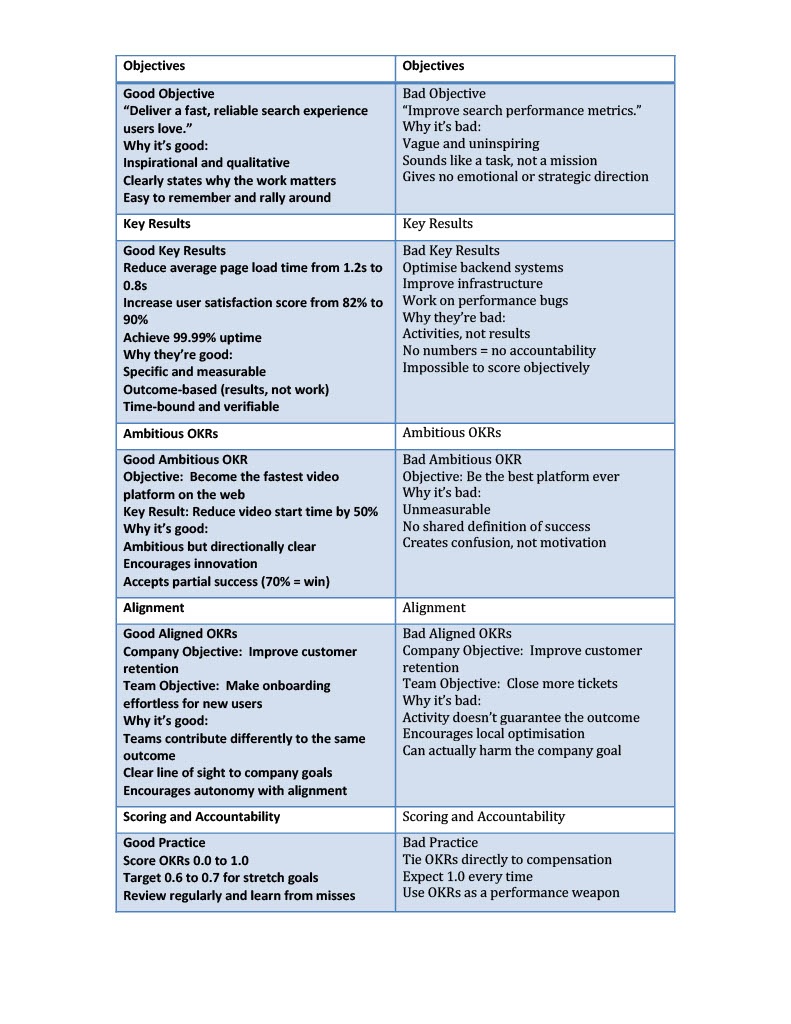
If you can complete the key result without changing outcomes, it’s a bad OKR.
The book and other resources

Measure What Matters
John Doerr
If you want your business to succeed and are keen to use OKRs as a way of focusing on one priority, then start by reading this brilliant and insightful book, Measure What Matters, by John Doerr.
Measure What Matters is about using Objectives and Key Results (OKRs), a revolutionary approach to goal setting, to make tough choices in business.
As with John’s philosophy, the execution of defining both Objectives and Key Results is the main focus. Through the many case studies featured in the book, John demonstrates how the OKR strategy has been successfully implemented in well-known and successful technology companies. This is clear in the Google OKR playbook section near the end of his book, where he says Objectives and Key Results written poorly are a waste of time.
“Management magic....Measure What Matters is a must read for anyone motivated to improve their organisation.” – Former Vice President Al Gore, chairman of the Climate Reality Project
If you want an introduction to OKRs, watch this video called ‘OKRs Explained’, where John Doerr, author of Measure What Matters, explores how Objectives and Key Results help leaders and teams set and achieve audacious goals.
And finally, here are a couple of YouTube shorts taken from The Radical Candor podcast on the secret to being a successful leader. There are more on YouTube if you want to dive further into the subject.
And if you want a more in-depth explanation on how to make OKRs work in your business, watch this interview with John Doerr as he digs into some of the issues holding businesses back. He talks about how to implement focus and direction to your business priorities.
If you want to dive into the detail on how Google sets their OKRs every 13 weeks (they’ve done this every quarter for the last 20 years!), here’s Rick Klau sharing a whole raft of detailed insights into how Google execute their OKR process.
What’s great about this video is that it describes Google’s early approach to OKRs and how they used them to kick-start their amazing success.
As Rick says: “Google wasn’t Google when it started using OKRs...”
YOUR SUPPORT TOOLS ARE HERE:
Click the button below and you'll be able to download a PDF version of this page.